

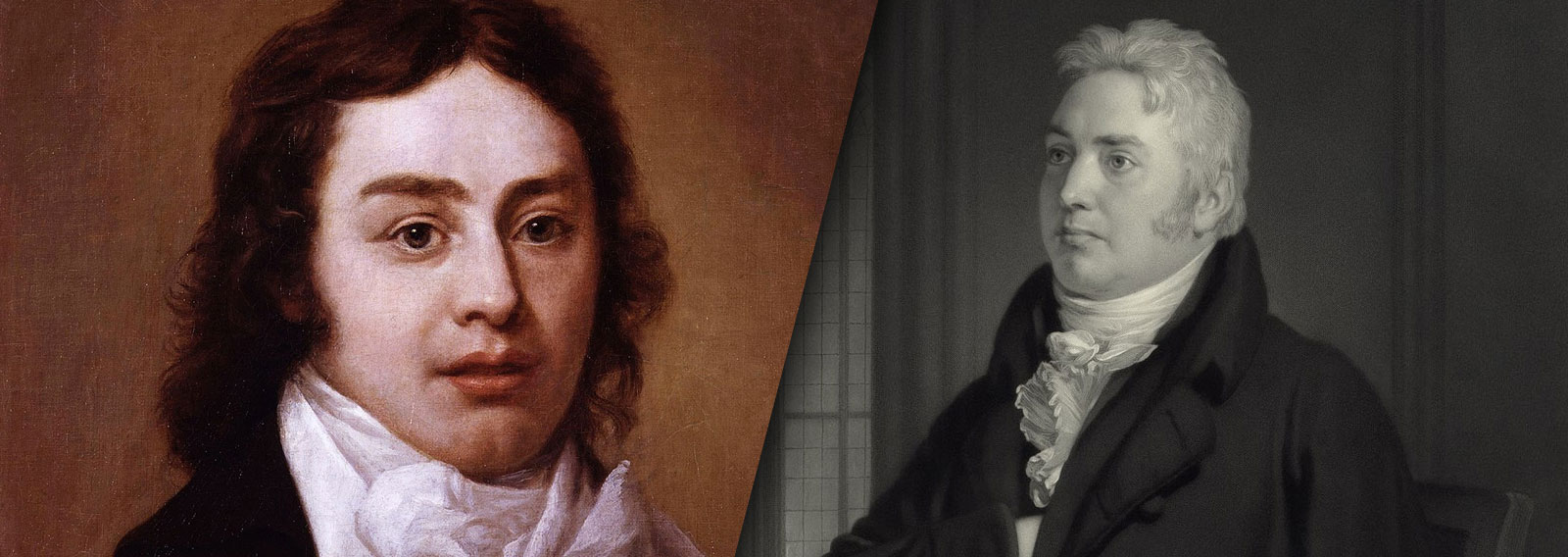
Samuel Taylor Coleridge was a man of faith, who like the rest of us, struggled from time to time. His poetry, some of which is tainted by “prescription” laudanum (the liquid variety of opium), can seem to us to be untouchable. Coleridge’s original meaning is almost unattainable.
Kubla Khan is a quintessential example, followed closely by his Aids to Reflection: Confessions of An Inquiring Spirit written in the latter part of his life. The work starts out strong but veers off in strange statements that appear unrelated to the whole.
Throughout his life, Coleridge moved from Christian orthodoxy towards Unitarianism and back again. Ever since my first encounter with Kubla Khan, Rhyme of the Ancient Mariner and Frost at Midnight, I’ve had an interest in this wild-at-heart eclectic 18th Century Christian.
Reading Coleridge is an adventure. Over the years I find myself finding new depth in the way Coleridge expressed his theology through poetry. It’s his theology that interests me. Especially where it becomes obvious in certain portions of his work.
One of the less obvious poems where Coleridge expresses his theology through poetry is ‘Ode to the Departing Year’, written near the end of 1796. The poem is nine stanzas long and reads like a political sigh.
Coleridge’s tone is sombre, firm; paralleling the same, very human gasps for breath, found in the imprecatory Psalms, which call on the name of Yahweh for guidance and deliverance.
Reflecting on this piece R.A Foakes wrote:
“…in such poems, Coleridge frequently falls into a sort of quasi-Miltonic heroics that morph into gothic melodramatics… but Coleridge was a man deeply engaged with the political problems of the time.”[ii]
It’s easy to agree because “Ode to the departing year’ was written during the late 18th Century, a ‘time of great political turbulence’ (Foakes, 2009:2).
The ‘French Revolution’ and its reign of terror, general turbulence in Europe, and war. A spiral of conflict triggered by the beheading of Louis XVI and Marie Antoinette in 1793.
‘Ode to the departing year’ is rich in imagery. It could be mined for days, by anyone with a keen theological eye who has the gusto to read, reread and discover the many new ways the passages could be understood.
For example, in its closing refrain Coleridge ends with an almost introspective note to himself:
“Away, my soul, away!
I unpartaking of the evil thing,
With daily prayer and daily toil
Soliciting for food my scanty soil,
Have wailed my country with a loud lament.
Now I recentre my immortal mind
In deep Sabbath of meek self-content;
Cleansed from the vaporous passions that bedim
God’s image, sister of the Seraphim.”[iii]
Understanding what Coleridge means by ‘sister of the Seraphim’, and how it is used in this context is difficult to determine.
I presume he means that nations stand alongside Angels in close proximity to God. Like the Seraphim, humans can also stand before God. Since in Christ, we are permitted to approach as freely as He has chosen to approach us.
The reference to Seraphim is strange. Does Coleridge mean the Seraphim of the Bible? If so, the image takes on a whole new picture when the historical context is applied.
“The “fiery serpents” for which the Israelites feared the desert (Num 21:6–8; Deut 8:15) become further embellished as “flying serpents” (Is 14:29; 30:6). The serpents, designated by the same Hebrew word as seraphim, are distinguishable from them only by context (Is 6:2, 6). This pairing suggests that the image of a seraph may have had more in common with our idea of dragon than of angel.”[vi]
The reference to the ‘Lampad seven’ indicates light, candle or torch. Perhaps even Light-bearer. Lampad is a term found in Greek mythology, a connection that Coleridge exploits in order to paint an image of blinding light.
“Throughout the blissful throng,
Hushed were harp and song:
Till wheeling round the throne the Lampads seven,
(the mystic Words of Heaven)
Permissive signal make:
The fervent Spirit bowed, then spread his wings and spake!
Thou in stormy blackness throning
Love and uncreated Light,
By the Earth’s unsolaced groaning,
… Seize thy terrors. Arm of might!…
The Past to thee, to thee the Future cries!
Hark! how wide Nature joins her groans below!
Rise, God of Nature! rise”
Coleridge may have borrowed from the significance of the imagery surrounding God’s heavenly throne in Revelation 4:5:
“From the throne came flashes of lightning, and rumblings and peals of thunder, and before the throne were burning seven torches of fire, which are the seven spirits of God, and before the throne, there was as it were a sea of glass, like crystal.” (Rev. 4:5, ESV)
There are ‘torches of fire, which are the seven spirits of God‘ gathered before His throne, along with the unique creatures (Seraphim) assigned to the task of protecting God’s Holiness.
Coleridge’s words are a lament. Carried with this is a solemn prayer. ‘Departing Year! ’twas on no earthly shore My soul beheld thy vision!’ War and calamity appear to be what the closing year has brought upon his world.
It’s not just the year, but the era that Coleridge now sees as being brought to a close. For Coleridge, this is the apocalypse. Hence Foalke’s comment about Gothic melodramatics that I mentioned earlier.
The only source of solace is in the one who commands Heaven and earth. Fixing eyes to heaven, even when ‘human ruin chokes the streams’; when ‘Ambition is marked in his war-array!’ and when nations take ‘mad avarice [as their] guide. [And] At cowardly distance, kindle with pride‘.
Coleridge isn’t alone. Minus the Gothic melodramatics, Peter wrote with a similar grasp of the times:
“The end of all things is at hand; therefore be self-controlled and sober-minded for the sake of your prayers. Above all, keep loving one another earnestly, since love covers a multitude of sins.Show hospitality to one another without grumbling. As each has received a gift, use it to serve one another, as good stewards of God’s varied grace: whoever speaks, as one who speaks oracles of God; whoever serves, as one who serves by the strength that God supplies—in order that in everything God may be glorified through Jesus Christ. To him belong glory and dominion forever and ever. Amen.” (1 Peter 4:7-11, ESV)
For the Christian, the New Year is also about an ending. It is a new beginning to the beginning of the end of all things. With the New Year, we are reminded that God owns time and space, just as He owns everything He created; and with that, we are reminded that God entered time and space in Jesus Christ, and we have His promise that He will do so again for the final time.
The New Year also a good time to be reminded that faith is not a feeling. Faith is lived out through prayer and gratitude. Faith impacts emotions and as such, it walks alongside reason. As such we should take a moment to reconsider all that we can be grateful for in the passing year. Laying down before God, as Coleridge does in Ode To the Departing Year, all that we may struggle with, giving over to God, also those things that have perhaps weighed us down or look to weigh us down.
With the New Year, we may not be able to see beyond the days ahead, but we are called by God to rest, recognise and acknowledge that He is the one who does. As the clock moves past 12 on the evening of 31st, may we too, sing with those gathered around His throne, “Holy, holy, holy, is the Lord God Almighty, who was and is and is to come!” (Rev. 4:8)
References:
[i] Foakes, R.A 2009, Shadowy nobodies and other Minutiae: Coleridge’s originality in The Coleridge Bulletin, The journal of the friends of Coleridge Summer new series 33 (NS) 2009
[ii] “beings who stand before God” (see Isa. 6:1–2), McGee, J. V. Thru the Bible
[iii] Coleridge, S.T 1796 Ode to a departing year in The complete poems, 1997 Penguin Classics, Penguin Group (p.126)
[iv] Ryken, L., Wilhoit, J., Longman, T., Duriez, C., Penney, D., & Reid, D. G. 2000 Dictionary of biblical imagery. Downers Grove, IL: InterVarsity Press.