

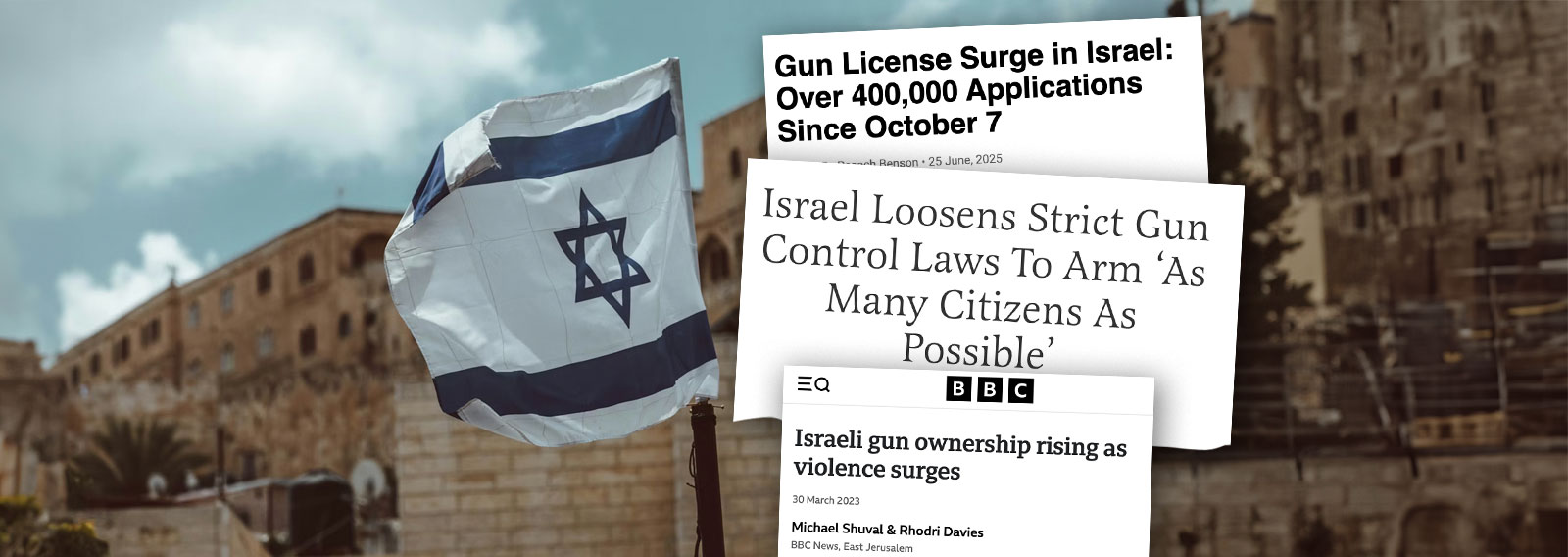
Following the Hamas terror attack on October 7, 2023, which killed over 1,200 people and led to the ongoing war, Israel did not implement a crackdown on gun ownership. Instead, the government actually expanded and encouraged legal firearm licensing within its regulated framework, resulting in a dramatic surge in applications and approved permits.
Prior to October 7, Israeli civilian gun policy was strict and controlled. Israeli citizens do not have an inherent right to gun ownership; they must apply for a license and meet strict conditions, including a clean criminal record, medical certification, and an explicit reason for needing a firearm.
Licenses are “may issue”, not automatic, and are carefully vetted. Each permit applies to a specific firearm, with tight limits on ammunition storage and frequent renewals.
However, in the months and years following October 7, Israel experienced an unprecedented rise in civilian gun license applications.
By mid-2025, over 403,000 gun license requests had been submitted since the attack — more than most of the previous two decades combined. Of these, over 217,000 received conditional approval and about 165,000 were finalised as permanent licenses.
Roughly 335,000 Israelis now legally own firearms, according to National Security Ministry data.
A separate report from late 2025 noted that more than 220,000 gun licenses had been issued since October 7, effectively more than doubling the number of licensed civilian firearms in the country compared with pre-war figures.
Rather than tightening restrictions, Israeli authorities — particularly National Security Minister Itamar Ben-Gvir — took steps that facilitated broader access to legal firearms.
Ben-Gvir explicitly supported expanding eligibility and processing applications rapidly to allow more citizens to arm themselves for personal and community defense, according to World Israel News.
Measures included temporarily empowering additional staff to process licenses and fast-track applications as demand surged. The government’s stance was that armed civilians could enhance security in an era of heightened terror threats.
While these steps did not remove the legal requirement to justify a need for a firearm, they relaxed procedural barriers and expedited approvals.
Not all changes went unchallenged. In November 2024, Israel’s High Court of Justice ordered a review of thousands of gun licenses issued after October 7, finding that some permits had been issued without proper legal authority under the Firearm Law of 1949.
The court’s decision underscored that, even amid emergency policy shifts, standard legal procedures remain integral to firearm regulation.
The licensing surge reflects widespread fear and insecurity among Israeli civilians following the attack, with many applying for weapons to protect themselves and their families.
Unlike Australia, Israel did not tighten gun ownership laws after October 7. Instead, there has been a major increase in civilian firearm licensing and approved permits.
Government policy, especially under National Security Minister Itamar Ben-Gvir, expanded access and sped up approvals.
The move illustrates a shift by the Israeli government toward encouraging legal firearm possession amid heightened security concerns, rather than imposing stricter restrictions.
In contrast, Australia’s federal and state governments have acted swiftly to reinforce the nation’s already strict gun laws. Prime Minister Anthony Albanese announced immediate reforms, including a nationwide gun buyback—the largest since the 1996 Port Arthur massacre—aimed at removing hundreds of thousands of firearms from circulation.
Additional measures include limiting the types of guns an individual may own, instituting periodic license reviews, expanding the use of intelligence data in background checks, and accelerating the creation of a national firearm register.
Furthermore, New South Wales Premier Chris Minns pledged to introduce the toughest state-level gun laws in the country, potentially banning certain rapid-fire mechanisms and conducting comprehensive audits of existing licenses.
The two nations have taken a fundamentally opposite approach. Israel considers legal firearm ownership a path to greater security, while Australia treats it as a liability to be curtailed and cracked down on.
Unfortunately, only time, and often tragic experience, will reveal which approach to gun policy works best.