

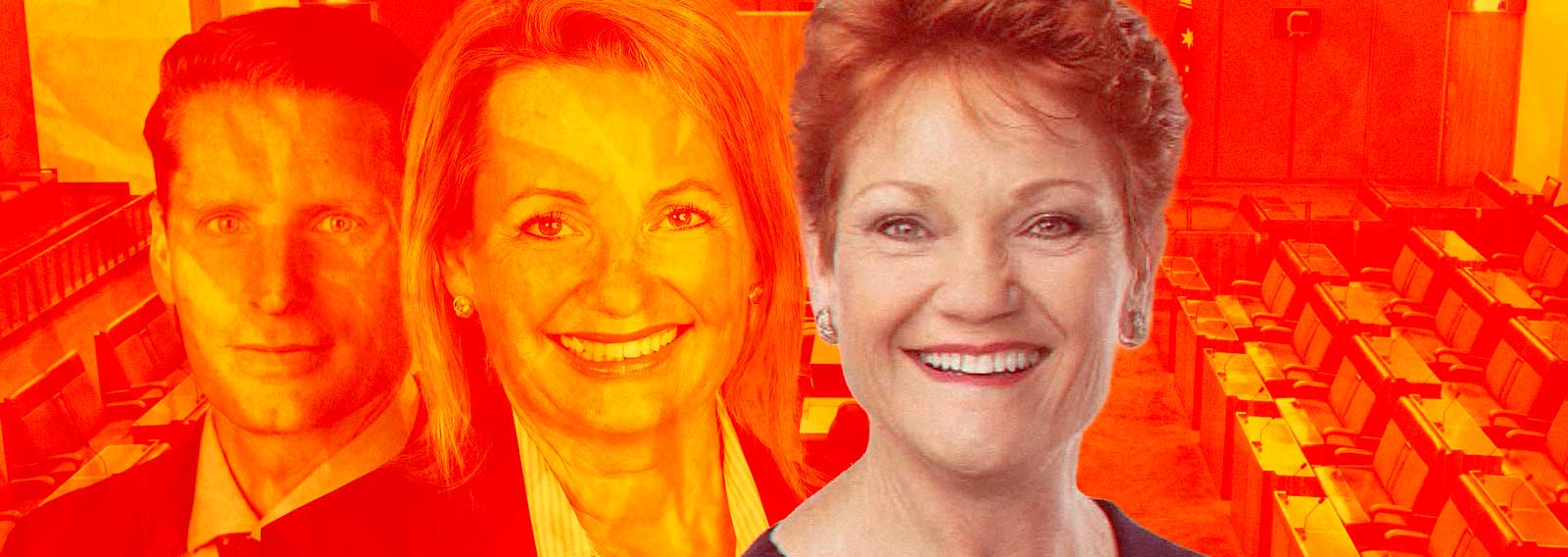
Yesterday, we ran a simple Facebook poll asking our followers a straightforward question: Who would you prefer to lead the country: Pauline Hanson or Andrew Hastie? Of more than 7,600 respondents, Pauline Hanson won overwhelmingly. Andrew Hastie attracted only a few hundred votes.
That result exposes a chronic and persistent failure on the Liberal Party’s part to read the room. For years, the Liberals have operated on a flawed assumption: that electoral success lies in winning over voters from the left by offering a softer, diluted version of Labor. The logic was simple: If this is what voters want, then this is what we must give them. What they failed to grasp is one of the most basic realities of politics: it is cyclical.
Voters move back and forth. Promises are made, hope is extended, and when those promises prove hollow or unworkable (and they usually do), voters abandon ship and look elsewhere. Cultural and political moods shift, often abruptly. We have seen this pattern repeatedly in the United States, the United Kingdom, across Europe, and beyond.
Progressivism, by its very nature, cannot stand still. It must always push forward. Once it settles, it ceases to be “progressive.” In practice, this means it eventually reaches the same endpoint that reductio ad absurdum reaches in debate: it exposes its own internal contradictions by pushing ideas to their logical extreme. And when progressivism reaches that end, the result is not cultural enlightenment but social and economic chaos.
As progressive policies become more radical, life becomes harder for the average citizen. As ambitions grow more abstract and disconnected from reality, public patience collapses. This is where the Overton Window comes into play. It does not remain fixed. The harder the progressive push, the faster and more forcefully it swings back the other way.
The Liberal Party failed to account for this. Instead of holding a firm, conservative line and waiting for the inevitable backlash against left-wing governance, they chased immediate cultural approval. In doing so, they backed the wrong horse at precisely the wrong moment.
One Nation, by contrast, remained consistent. It did not chase the culture. It did not soften its message to appease progressive sensibilities. It stayed put, committed to its convictions and seemingly knowing that eventually the wheels would come off left-wing propaganda and that a Labor government would expose its own incompetence and ineptitude. When that moment arrived, voters would not be looking for “Labor-lite.” They would be looking for something clearly and unapologetically different.
That moment has arrived.
Sometimes it takes a genuinely bad government to nudge the public in the right direction. Albanese’s government has done exactly that. Yet the Liberals were nowhere to be found—not because the opportunity didn’t exist, but because they lacked the patience and foresight to wait for it.
If the Liberal Party truly believed Labor’s policies would fail, all they had to do was stand firm and let reality do the work. Instead, they tried to pre-empt the pendulum, repositioning themselves before the swing had occurred. In doing so, they ceased to be an alternative at all. It’s why the two major parties in Australia are often described as the “Uni-Party.”
Now it is too late.
Installing someone like Andrew Hastie at this stage cannot rebuild trust that has already been squandered. Especially after he backflipped on Labors disgraceful hate speech bill. He might have had his reasons for doing so, but the optics were just terrible. The public feels betrayed. They have placed their confidence in the Liberal Party before and received the same outcome: compromised principles and progressive drift. Voters have learned the lesson.
Had the Liberals understood the oscillating nature of politics, they would have waited. They would have allowed Labor to fall on its own sword and then stepped forward as a genuine alternative. Instead, they dropped the ball entirely. Whether because they doubted Labor would fail or because they lacked the courage to endure short-term unpopularity, the result is the same.
The Liberals have rendered themselves politically irrelevant. Australians are now looking for a real alternative, not a watered-down version of what’s already left a shockingly bad taste in the mouths of the public.