

In 2012, the world was meant to end. The Mayans had predicted it, and Hollywood even had a movie about it happening the day after tomorrow. But it was still the early days of social media virality. Suddenly, Churches in the West were not just aware of starving children in ‘the third world’, but also of persecution all over the world.
Kony 2012 is a campaign that churches and Christian organisations (and schools) got behind and decided that something needed to be done about it. It’s hard not to be cynical about the whole affair, as if an ongoing conflict can be condensed into a 30-minute documentary that looks more like a recruitment drive for the world police.
With plenty of voices in and out of Nigeria claiming that the government in Nigeria is turning a blind eye to a genocide of the Christian population, Boko Haram is back in the headlines after their 2015 media frenzy. The prudent questions would be: Did they ever stop persecuting Christians? And why should the West do something about it now?
It’s not wrong to be outraged. As a Christian, I am appalled at the violence and brutality directed at fellow believers. I want it to stop. However, there are plenty of people in Nigeria who point out that Muslims are also on the receiving end of the violence. The government claims the perpetrators and criminals, and extremist groups, are in a perpetually violent northern region of the country. Maybe the US could suppress those responsible, but at what cost?
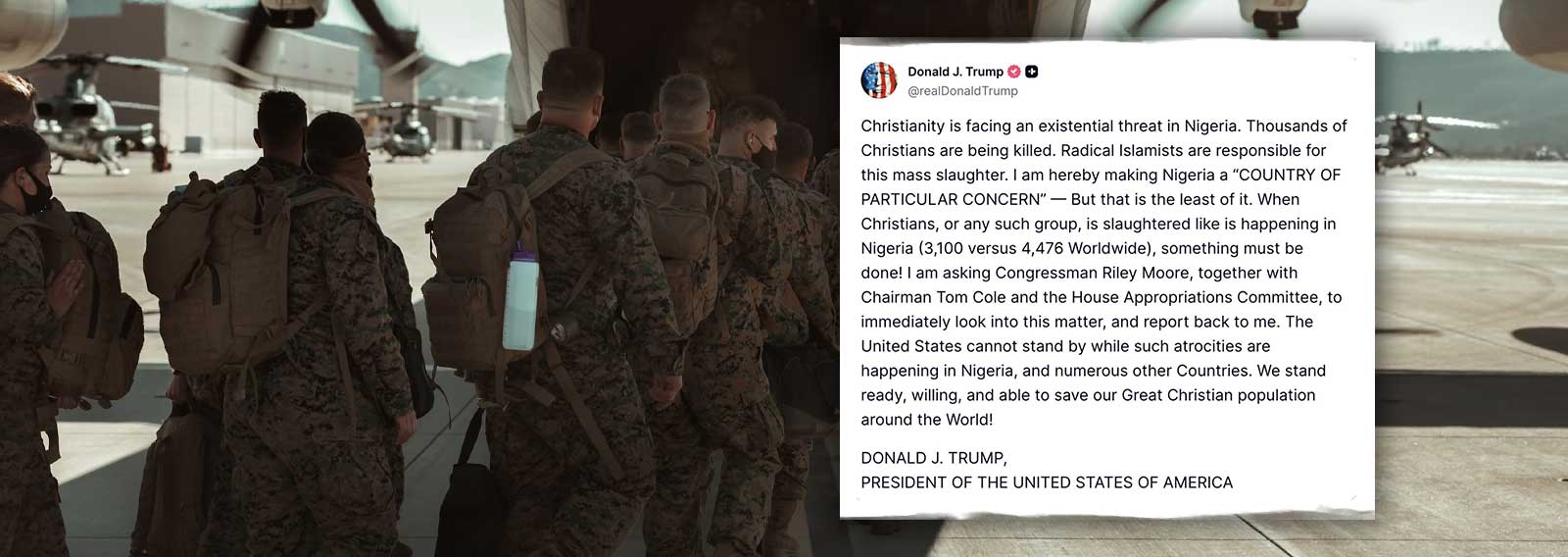
The United States is again being urged toward military engagement in a complex, decade-plus conflict. Declaring Nigeria a “Country of Particular Concern” (CPC) may have symbolic value, but the leap to armed operations is a different matter entirely. The history of US military intervention should give us pause.
Consider the ledger. Vietnam cost immense blood and treasure and did not produce a desirable outcome; its toll still haunts American families and veterans. The change in Vietnam happened much later and without being imposed on the population. Somalia, twice, demonstrated how humanitarian justifications can slide into chaotic firefights and rapid exits. “Black Hawk Down” remains the shorthand for mission creep and urban warfare catastrophe.
Does US involvement just hinder local political progress and prolong conflict rather than resolve it? Sure, you can impose a ‘peace’, but nothing has really been solved in the broader conflict. Just look at Afghanistan. The Taliban’s return, a traumatic evacuation, and the US President declaring the evacuation a success, like the emperor showing off his new outfit. The greatest achievements of the campaign in Afghanistan have been the amount of US military hardware in the hands of Islamists and the number of Afghan refugees inhabiting the West.
In Yemen, U.S. support to the Saudi-led coalition and subsequent direct strikes have fuelled one of the world’s worst humanitarian crises, with repeated allegations of civilian casualties and legally dubious targeting decisions. Human rights monitors have raised serious concerns about recent operations as well. How, exactly, has this improved the safety of Christians (or anyone) in Yemen?
Iraq and Syria offer an even starker indictment. The 2003 invasion dismantled a fragile equilibrium and opened a vacuum that ultimately birthed ISIS. This is the same Islamist movement that has targeted and massacred Christians across the Middle East and beyond. Post 2003, Iraq’s Christian population plummeted by more than half, with many forced into exile. Multiple reports chart the long decline: from potentially 1.5 million to a fraction of that today. Whatever geostrategic goals Washington claimed (e.g., removing Saddam or degrading ISIS), the net effect for Christians was catastrophic displacement and insecurity.
Libya illustrates the same pattern: NATO’s 2011 intervention, celebrated at the time, produced a failed state, enduring civil war, and a major migration route into Europe. The destabilisation of the region allowed the reopening of the slave markets, and Libya as a nexus for migration out of Africa into Europe.
And long before ISIS, U.S. interference in Iran (the 1953 coup) sowed seeds of hostility and instability that still shape the region. Declassified records and encyclopedic summaries confirm the CIA’s role in overthrowing a democratically elected government, with decades-long blowback. Evangelical believers in the Middle East and diaspora communities continue to live with the consequences of these decisions.
But we’ve read the script before. I mean, we’ve even watched the movie as well. “Kony 2012” remains the archetype. The viral advocacy that framed Ugandan (and regional) dynamics in simplistic terms, ignored local voices, and promoted militarisation as the silver bullet. The “white saviour” trope exists for a reason, and the current calls for intervention in Nigeria show it is far from being past its used-by date. What is it about Christians that they clap like seals when a celebrity takes a break from promoting pornography to mention ‘God’ in a tweet?
It’s almost like these public figures get paid to promote things on social media, and all they have to do is mention buzzwords like ‘Islamist’ and ‘God bless’ and the programming kicks in.
Take the 2014–2015 #BringBackOurGirls campaign. No one cared that Boko Haram had a habit of kidnapping boys. Global celebrities and political figures (including Michelle Obama) poured attention onto the Chibok kidnappings (276 schoolgirls); public outrage nudged governments to send advisers and expand security cooperation.
We’re 10 years past that, and how many girls are still missing? What about Boko Haram? Far from gone, it metastasised into factions like ISWAP. Digital activism raised awareness, but it neither solved root causes nor “defeated” insurgency. The organisation is stronger than ever and has expanded its activities. Ah, but isn’t that because ‘we’ failed to destroy them the first time? Considering that would probably mean solving the country’s economic woes, it’s not so simple.
For Christians, the deeper issue is not merely whether intervention “works” by secular metrics. It is the worldly temptation to impose our will on other countries through carnal, imperial means. It does no good to dress up the desire in humanitarian terms or religious solidarity. Scripture warns against trusting in horses and chariots (Psalm 20:7), substituting sword-wielding power for patient justice, persuasion, and prayer. The modern record shows that these ventures reliably make life worse at home and abroad.
Domestically, repeated wars and engagements have ballooned the national debt and created a perverse pull factor for refugees displaced by Western intervention. ‘The Right’ cheer on military action in places like Vietnam, Afghanistan and Syria, then ‘The Left’ agitate to take in displaced people because ‘we’ created the mess. Libya’s postintervention migration corridor and Iraq/Syria’s refugee waves are not speculative; they are measurable outcomes that European countries, in particular, continue to struggle with.
Deposing a tyrant, or temporarily suppressing a terrorist group, might seem attractive, but the net effect for local Christians has frequently been negative, with churches destroyed, believers scattered, and laws further targeting Christians for persecution. Aid groups working with Iraqi Christians still document the security threats, militia control, economic devastation, and discriminatory legal frameworks in place. In other words, military “victory” did not translate into Christian safety, dignity, or flourishing.
What would a “fast, vicious” U.S. operation in Nigeria accomplish? The Nigerian government voices itself, emphasises their sovereignty, and disputes claims of a singularly anti-Christian campaign; analysts caution against U.S. unilateralism in a sovereign state of 220 million. Labelling Nigeria a CPC may allow sanctions to be employed, but it is no way likely to improve the lives of Christians there when many of the root causes are economic.
The heart of the matter is whether or not we can solve Nigeria’s problems, or do they have to solve those themselves. There is an aversion in the ‘West’ to allowing other countries that sort of freedom. Further to this, sometimes when they are solved, the solutions are not to our leaders’ satisfaction. Sometimes the best practical approach is to pray. If it is something that stirs the hearts strongly, then burn it into your prayer habit as a regular thing. There is nothing stopping us as Christians from partnering with Nigerian churches to assist in financially supporting their development and witness. Why is it that we are reticent to help for fear of being swindled by a ‘Nigerian Prince’ but will happily beat the war drums for a ‘Prince’ closer to home?
Let us, then, reject the seductive lie that violence from afar can redeem a complex conflict. Christians should be cautious (suspicious, even) of U.S. governments that have reliably ignored the church on the ground or instrumentalised her for geopolitical aims. We’re meant to be wise as serpents and innocent as doves, but many Christians are little different from the mobs we see tossed to and fro by emotionally manipulative media. Kony 2012 was an experiment in what buttons to press. As followers of Christ, we should avoid being the cheerleaders for another geopolitical disaster.