

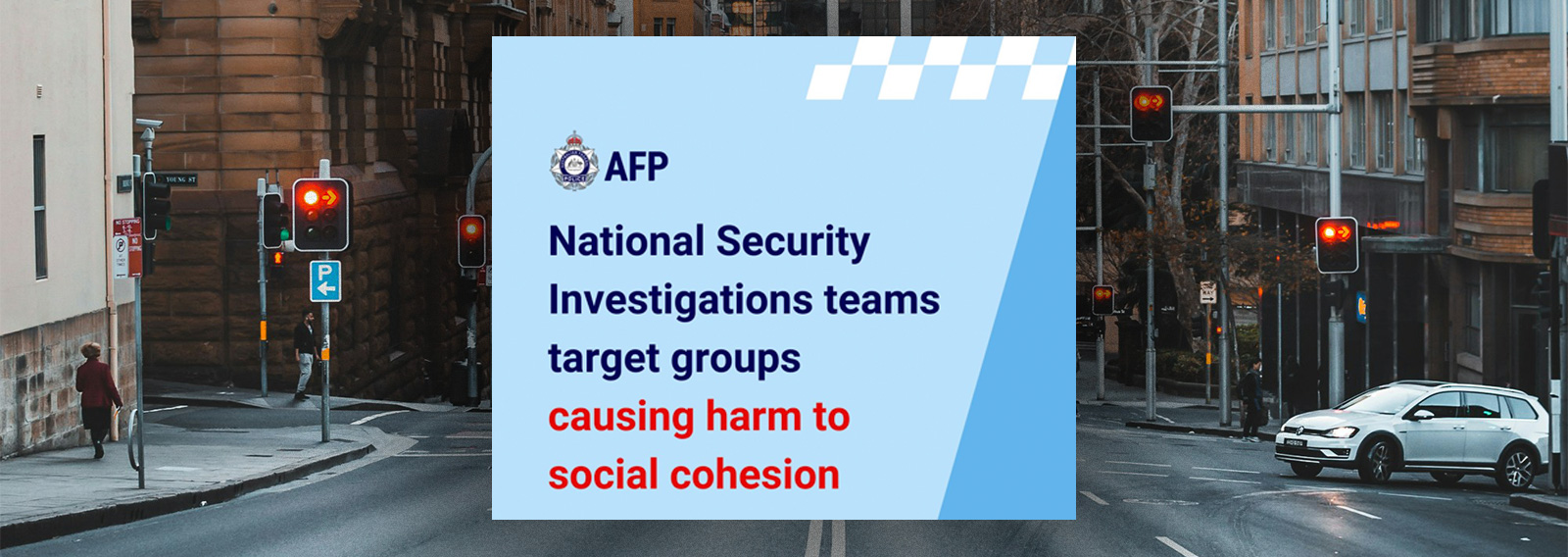
The Australian Federal Police (AFP) appear to have taken a page from the UK’s playbook with the launch of a new taskforce targeting groups allegedly “causing harm to social cohesion.”
According to an AFP media release, the new National Security Investigations teams will work with state and territory police, law enforcement, and national security partners “to provide a coordinated, consistent and intelligence-led response to security threats,” while also engaging internationally “through operations, capabilities and relationships with the global law enforcement intelligence community.”
The AFP explained its rationale, stating: “There are current and emerging groups dispersed across Australia and overseas who are eroding our country’s social fabric by advocating hatred, fear, and humiliation. While many of these crimes may not meet the threshold of terrorism, the AFP has identified concerning behaviours which could escalate to politically motivated violence or hate crimes, which seriously put the Australian community at risk.”
“There is no place for hate or violence in our communities, and the AFP will defend and protect Australia and Australia’s future from these threats.”
But let’s be clear about this: We already have laws prohibiting intimidation, incitement to violence, threats, and harassment. All of those things are rightfully deemed illegal. That’s not what many have taken issue with.
While no one disputes the importance of preventing violence, the concern many have lies in the increasingly subjective nature of what is now deemed “hate.” In recent years, Australians have seen Christian beliefs about marriage, sex, and gender routinely branded as “hateful.” So, the critical question is, by what standard will the AFP determine “hate”?
If traditional Christian views can be labelled “hate” by progressive standards—and those same standards are echoed by politicians and the media—then “hate” ceases to mean objective harm and becomes a measure of ideological offence.
The goal of “social cohesion” sounds noble, but how can one prove who is causing division—the person who states something, or the person who takes offence? If the test is simply whether someone feels offended, then virtually any statement, no matter how benign, can qualify as “hate.”
We’ve already witnessed it. For some, declaring that men cannot become pregnant is hate. For others, proclaiming that Christ is King is hate. For others still, saying that marriage is between a man and a woman is hate.
Outside of Christianity, there is no universal definition. What one group deems hateful, another may call truth. What one faith condemns, another celebrates. In a pluralistic society, “hate” becomes an arbitrary and shifting measure—determined by those who hold cultural power at the moment.
Christians, for instance, are commanded to hate what is evil. Yet much of what Scripture calls evil, the world now celebrates as love. Are we to expect a knock at the door because our faith conflicts with the state’s evolving moral orthodoxy?
By all means, the state should police violence and genuine incitement to harm. But “hate” laws that target non-violent speech—beliefs, convictions, or moral dissent—are effectively criminalising thought itself.
Has the UK not shown us where this leads? In 2023, British police made over 12,000 arrests for online communications—an average of 33 arrests per day, up 58% since 2019.
Civil liberties groups have long warned that such policing creates a “chilling effect” on free expression. The mere possibility of arrest—regardless of conviction—can cause mental distress, public shame, job loss, and lasting stigma. Citizens increasingly self-censor, not because they are violent or hateful, but because they fear the consequences of expressing unpopular opinions.
When fear silences speech, democracy becomes an illusion. When only state-approved ideas can be voiced, freedom of expression is dead.
Free speech—the ability to debate ideas without fear of reprisal—is not a luxury; it is the foundation of democracy itself. Without it, the democratic process collapses.
If laws threaten citizens with prosecution for “wrong-speak,” ideas can no longer be freely tested, challenged, or refined. Even unenforced, such laws cast a long shadow of fear, shaping public discourse through intimidation rather than persuasion.
To regulate speech is to regulate democracy itself. And a democracy where the state decides which ideas may or may not be expressed is, by definition, no longer democratic.
If “social cohesion” can only be maintained by suppressing speech, then it comes at the cost of freedom—and democracy. You might preserve a surface-level harmony, but it will be the silence of fear, not the unity of truth.
Sacrificing free speech to preserve “social cohesion” is, in the end, self-defeating. Without freedom of speech, there is no freedom of thought, no diversity of opinion, and no genuine government by or for the people.
A society that must silence dissent to remain “cohesive” has already ceased to be free.