

Australian politicians are now scraping the absolute bottom of the barrel in their attempts to justify the forced march toward radical multiculturalism. Their latest defence? Food.
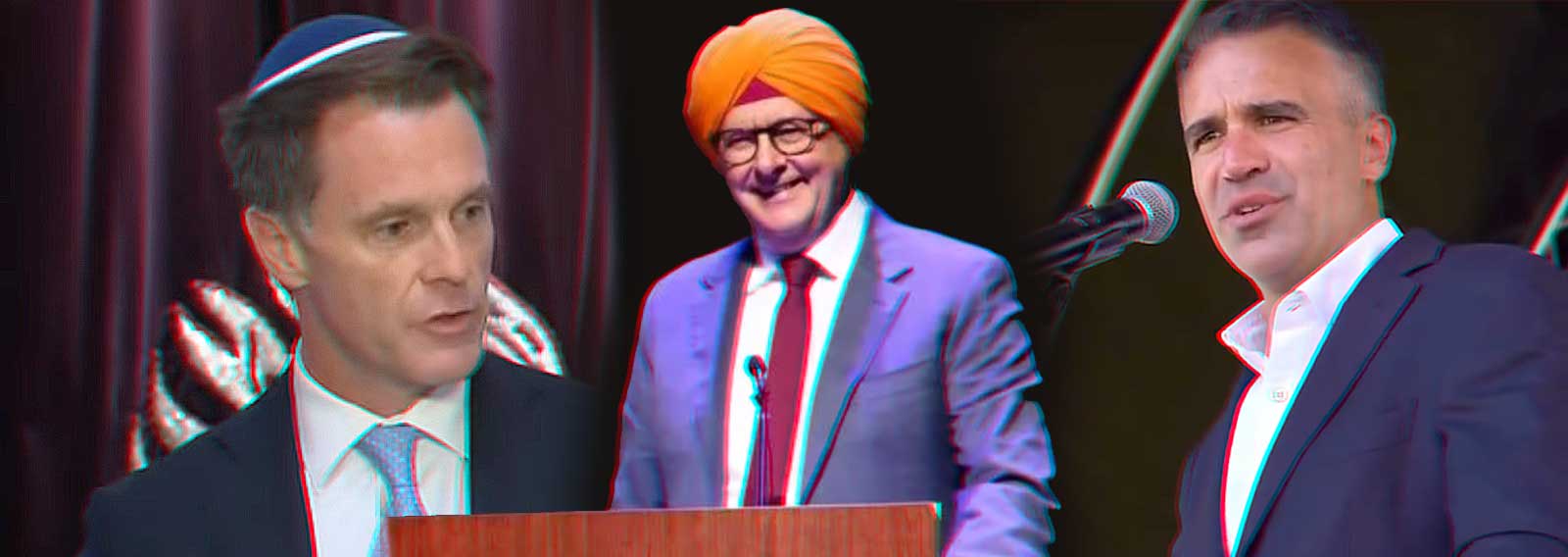
Just months after New South Wales Premier Chris Minns openly admitted that multiculturalism requires restricting free speech, South Australian Premier Peter Malinauskas offered an even more surreal justification: without multiculturalism, Australia would be boring.
Speaking publicly, Malinauskas lamented the horror of Australian “monocultural society.”
“Living in a monocultural society, it would be so boring. The food would be all the same. If we walked down Rundle Street and went out for a feed, it’d be all the same restaurants. I couldn’t think of anything worse. The music would have no richness and colour. We wouldn’t see different dance performances…”
Thanks, Pete. Tell us what you really think of Australian culture. Australian culture was apparently so bland and lifeless that we needed large-scale demographic replacement to rescue us from beige cuisine and dull dance routines.
The comments went viral — and not by coincidence. They followed backlash against Piers Morgan, who recently said that he’d gladly trade “a lot of white English people” for the convenience of a good weekly chicken tikka masala.
Is this really the intellectual firepower behind the most radical social transformation in modern history?
Multiculturalism, evidently cannot be defended on moral grounds, civilizational grounds, or freedom grounds — but don’t worry, the curry is great.
The absurdity would be funny if it weren’t so dangerous.
Because the politicians advocating this transformation rarely mention the price tag.
Chris Minns did.
During a press conference announcing expanded police powers, the NSW Premier acknowledged what most leaders carefully avoid saying out loud:
“I completely acknowledge we don’t have the same free speech and inverted commas laws that they had in the United States. They’re different,” Minns said.
“The rules on the safeguards that were put in to stop vilification, humiliation, [and] racist abuse are a direct response to a multicultural community that we built in this country — and the public’s desire to protect it. It is not something that we should automatically assume is free from those kinds of divisive, hate-filled public debates.”
In other words, Australia’s restrictions on speech exist because of multiculturalism.
This is not the first time the Premier has linked restrictions on speech to the preservation of multicultural harmony. In March, he made similar remarks that went viral on social media, with many users expressing shock at what they saw as a “quiet part out loud” admission, namely, that multicultural communities are too fragile to withstand unrestricted freedoms.
Let that sink in.
A social model that collapses without censorship is not a strength — it’s an indictment.
But apparently, we’re expected to sacrifice centuries of free-speech tradition for lamb korma.
Because food.
Nobody opposes multiculturalism because they hate foreign cuisine. That argument insults the intelligence of the Australian public. Recipe books exist. Immigration policy is not required to access pad thai.
The objections to multiculturalism are far more serious, and they remain completely unanswered.
To offer just a few:
First, we are told the system is so delicate that it requires permanent limits on freedom to remain stable. If our liberties must be sacrificed to sustain it, why should we believe it’s superior to the culture it replaced?
Second, multiculturalism rests on radical cultural relativism — the idea that all cultures are essentially equal. That is demonstrably false. Some cultures produce societies of liberty and trust; others do not.
Third, it assumes that all cultures share a commitment to diversity and peaceful coexistence. They clearly don’t. Multiculturalism itself is a uniquely Western value — most cultures do not embrace it once in majority power.
Fourth, multicultural societies contain a built-in self-destruct sequence: once a group gains demographic dominance that rejects multiculturalism, the ideology collapses. Multiculturalism is transitional — a pathway not toward permanent diversity, but toward replacement.
Fifth, the ideology denies that Australia even has a distinguishable culture of its own. If “Australian culture” is merely a patchwork of imported identities, then it effectively does not exist — a form of slow-achieving cultural erasure.
Sixth, culture flows downstream from religion. When incompatible cultures are imported, so are incompatible moral systems. Multiculturalism does not unite diversity — it fragments society along spiritual fault lines.
The result is not unity, but superficial coexistence enforced through speech controls, surveillance laws, and the policing of dissent — especially against those who wish to preserve Western traditions and values.
And for what?
Chicken tikka masala.
We are watching Western leaders trade a civilizational inheritance for a bowl of soup.
Scripture captured this tragedy long ago. Esau sold his birthright to his brother Jacob for a single meal: “Esau despised his inheritance.”
That is our moment, the forfeiting of Western civilisation for fleeting comfort and cultural novelty.
Hebrews offers the warning: “See that no one is godless like Esau, who for a single meal sold his inheritance rights… Afterwards, when he wanted the blessing, he was rejected, though he sought it with tears.” (Hebrews 12:16-17)
The Western world is a blessing, built by Christian men on Christian foundations, producing the safest, freest, and most prosperous societies in history. People flee broken nations to reach the West, not the other way around, not because we mirror the cultures they leave behind, but because of the distinct civilisation we built.
That civilisation is worth preserving.
It is worth protecting.
And it deserves a stronger defence than takeaway menus.
Because some inheritances, once sold, can never be bought back.