

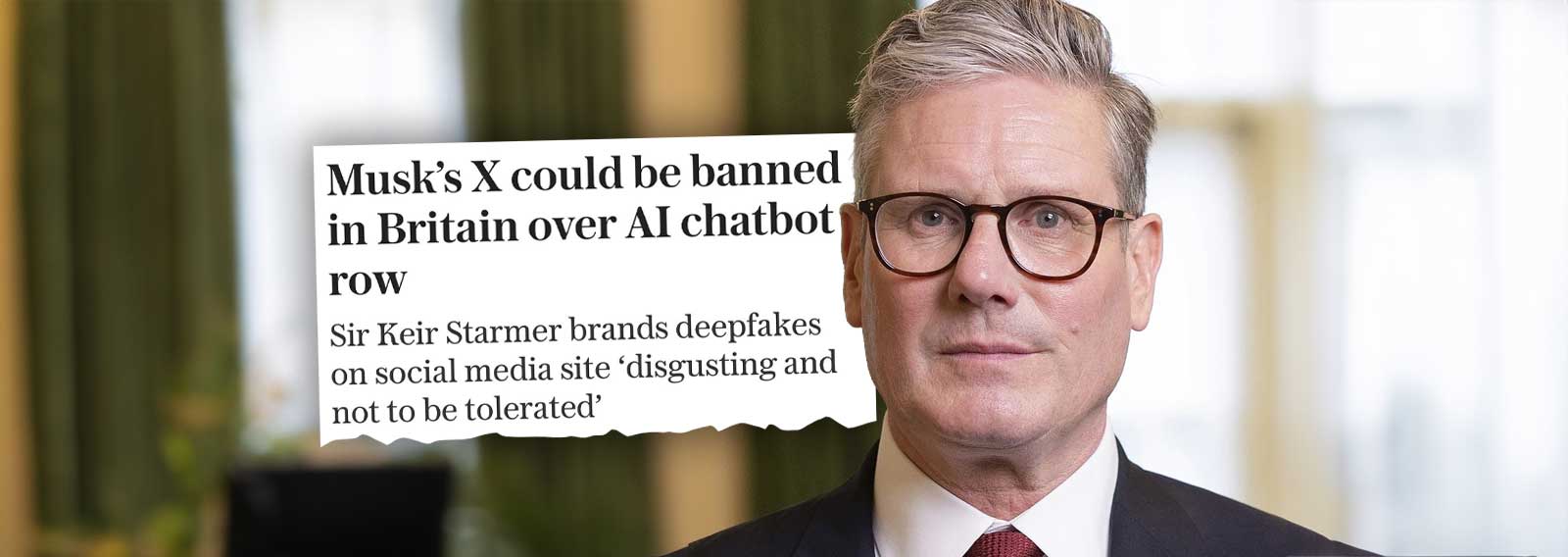
The UK government’s threat to ban access to X is being portrayed as a righteous crusade to protect women and children. And to be clear, the concern being used to justify it is real. Sexualised deepfakes truly are vile. Of course, the use of AI to sexualise women and children deserves condemnation without qualification.
But let’s not be naïve either. A legitimate grievance is being weaponised to achieve something far broader: greater government control over speech.
According to reports, the controversy centres on Grok, X’s AI chatbot, which has been used to generate sexualised images of real people. Prime Minister Keir Starmer and Technology Secretary Liz Kendall have responded with theatrical outrage, calling on Ofcom to deploy the full force of the Online Safety Act — including the nuclear option of blocking X entirely.
Yet this sudden moral conviction comes from the same political class that seemingly looked the other way while grooming gangs operated for years. Forgive the public for not taking your sudden interest in protecting young girls seriously. If they were serious, Grok wouldn’t be their only target. Other AIs, such as ChatGPT and Gemini, are programmed to produce the exact same result.
The issue isn’t just Grok. It’s that X remains one of the last major platforms unwilling to submit to far-reaching, regulatory speech control. That makes it a problem. The issue of sexualised AI content simply provides the necessary excuse for the government to “fix” that problem.
But here’s the thing: the public helps create that excuse, too.
When a society becomes morally lax, when degeneracy is tolerated, celebrated, or even defended as “free speech”, it hands the state a pretext on a silver platter. Governments don’t need to invent reasons to expand their power. They wait until enough people behave badly, then step in as the “solution.”
Every society will be regulated. The only question is by whom.
Either we regulate ourselves through shared moral norms, higher standards, and social consequences, or else the state will do it for us, with laws, surveillance, and punishment. When self-regulation disappears, state regulation becomes inevitable.
The state doesn’t care about personal virtue and integrity. It cares about control. It doesn’t move to preserve morals. It moves to expand its reach into our lives. As such, public immorality is not a threat to government power. It is the gateway to it.
This is why liberty without virtue is suicidal. When people abandon self-restraint, abolish shame, and reject standards entirely, they don’t free society. They invite the regulator, the censor, and the bureaucrat into their homes. Without disorder, the government struggles to justify this intrusion. With disorder, it becomes not only easy but popular. The public welcomes it!
But the answer is not begging the state to fix what culture has broken. The answer is rebuilding culture itself. That means, as a collective, we need higher morals. We need clear boundaries. We need to restore Christian social norms. We even need to revive the practice of shaming those who push society toward moral ruin.
Not because we are inquisitorial puritans, but because public degeneracy doesn’t just corrode society, it empowers the state. Once enough people normalise moral disorder, government intervention stops being the exception and becomes the rule.
If we want less censorship, less surveillance, and less state control, we must give the government fewer excuses to justify it. Self-regulation beats state regulation every time.
Fail to govern ourselves, and we will be governed by the state, aggressively, permanently, without apology, and to the applause of the public.