



A recent study by the Barna Group indicates that church attendance among Gen Z and Millennial men is rising, surpassing older generations for the first time in decades.
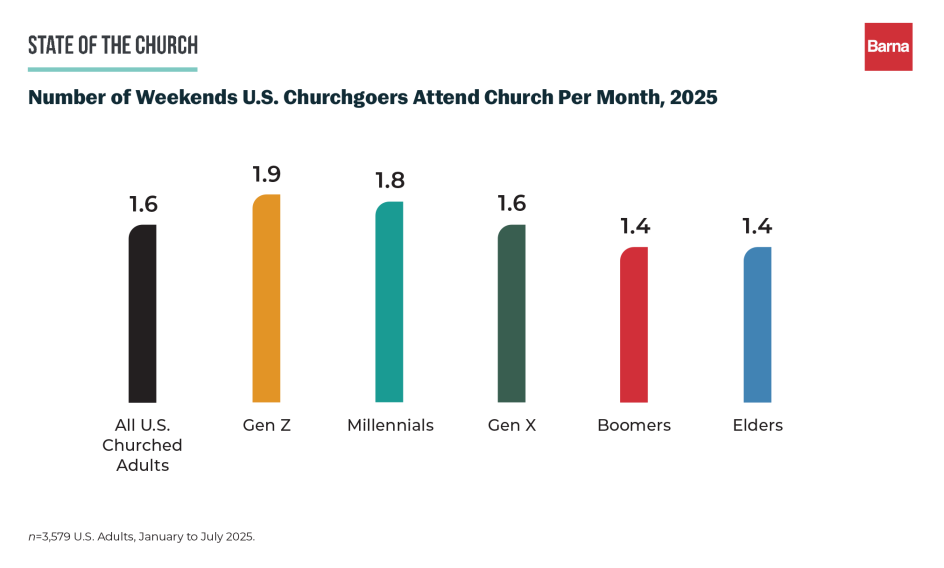
According to Barna’s research, younger adults—Gen Z and Millennials—are now the most regular churchgoers, marking a shift from previous decades when older generations formed the bulk of attendance.
The findings come as part of Barna Group’s ongoing State of the Church initiative with Gloo, which tracks trends in faith and spiritual engagement. The study highlights growing interest in Christianity among younger generations alongside increased frequency in church attendance in the United States.
The typical Gen Z church attendee now participates in 1.9 weekends per month, while Millennials average 1.8 weekends. These figures represent the highest rates of church attendance among young Christians since Barna began tracking the data, reflecting a steady upward trend since pandemic lows.
Church attendance in the United Kingdom is experiencing a similar resurgence, especially among young adults, according to The Quiet Revival report by Bible Society UK. The study, conducted with YouGov, found over two million more people attending church than six years ago—a 50% rise that challenges long-held narratives of Christian decline.
The strongest growth is among 18–24-year-olds: monthly attendance has risen from 4% in 2018 to 16%. Among young men, it has climbed from 4% to 21%, and among young women, from 3% to 12%—a trend showing no signs of slowing.
Pastor Tom Foord of Hope Reform Baptist Church noted a similar demographic trend within his congregation. Speaking to Caldron Pool, Foord said the church’s largest group comprises males aged 18–29, followed by females in the same age range. Remarkably, boys aged 0–10 form the third-largest group—reflecting a wave of young couples marrying and raising families.
According to Foord, the majority of ministry leaders, Bible study leaders, worship leaders, deacons, and staff are between 20 and 30 years old. “Gen Z are not only our most represented but also our highest serving demographic,” he said, adding that most young attendees participate in both Sunday services each week.
Foord emphasised that a healthy church encompasses all ages, describing it as “the body of Christ, made up of saints of all ages.” While enthusiasm about Gen Z’s involvement does not exclude older members, he said it “prioritises the future over the past,” seeing younger believers as “the parents, builders, owners, investors, preachers, and leaders of the future.”
He believes the strong Gen Z presence signals “a significant resurgence in Christian faith that is sustainable, though surprising.” Reflecting on the theological basis for this optimism, Foord said, “Jesus died for sin and rose to life, and is now sitting at God’s right hand as king and ruler of the world. The Scriptures compel us to be optimistic about what God can and will pour out, by grace. May He send a genuine revival of preaching, conversion, and church planting.”
Pastor Vaughan Smith, minister at Taree Presbyterian Church, said it was unsurprising that younger generations are turning to the historic Christian faith.
“A generation that has been repeatedly lied to about the so-called wisdom of our age and the morality of our culture of death,” he said, “would naturally find comfort in the life-giving truths of generations before us.”
Pastor Matthew Littlefield of New Beith Baptist said young adults are being drawn to forms of Christianity that emphasise masculinity in men and femininity in women, though not necessarily high-church traditions.
“They are deeply thoughtful and recognise that our culture has gone crazy with liberalism and progressivism,” Littlefield said. “Some are theological tourists; they want to explore the varied theologies of the old school church, and are rarely impressed with the things their parents and other older people were interested in. They are far more interested in substance than show.”
Littlefield noted that these young Christians actively seek connection with older Christian traditions, often reading historic theological works by figures such as Augustine, John Owen, and Luther. “They don’t want to be pandered to—they want to fit into a church and family network that connects them with older Christian traditions,” he said.
He added that this generation will likely challenge church leadership, often finding it wanting, but sees their engagement as a hopeful sign for the future of the Church.
Barna Group said if these trends continue, “the spiritual explorations of the next generation could redefine the makeup and momentum of Christianity and of congregations in the coming decade.
“The data points to a future where the vitality of the Church may hinge on how well leaders engage the spiritual curiosity and commitments of younger adults.”




















You must be logged in to post a comment.