

Christian forgiveness is a paradox.
When you’ve been dragged through hell and high water over and over again, forgiving doesn’t seem like the road to freedom.
Unforgiveness, hatred, and perpetual rage make more sense.
In truth, these only pin us to our pain, harbour sin, and keep us strapped to those who’ve sinned against us.
Tim Allen gets this, and so does Erika Kirk.
Inspired by Kirk forgiving her husband’s assassin, the king of sitcoms said after 60 years, he was moved to forgive his father’s killer.
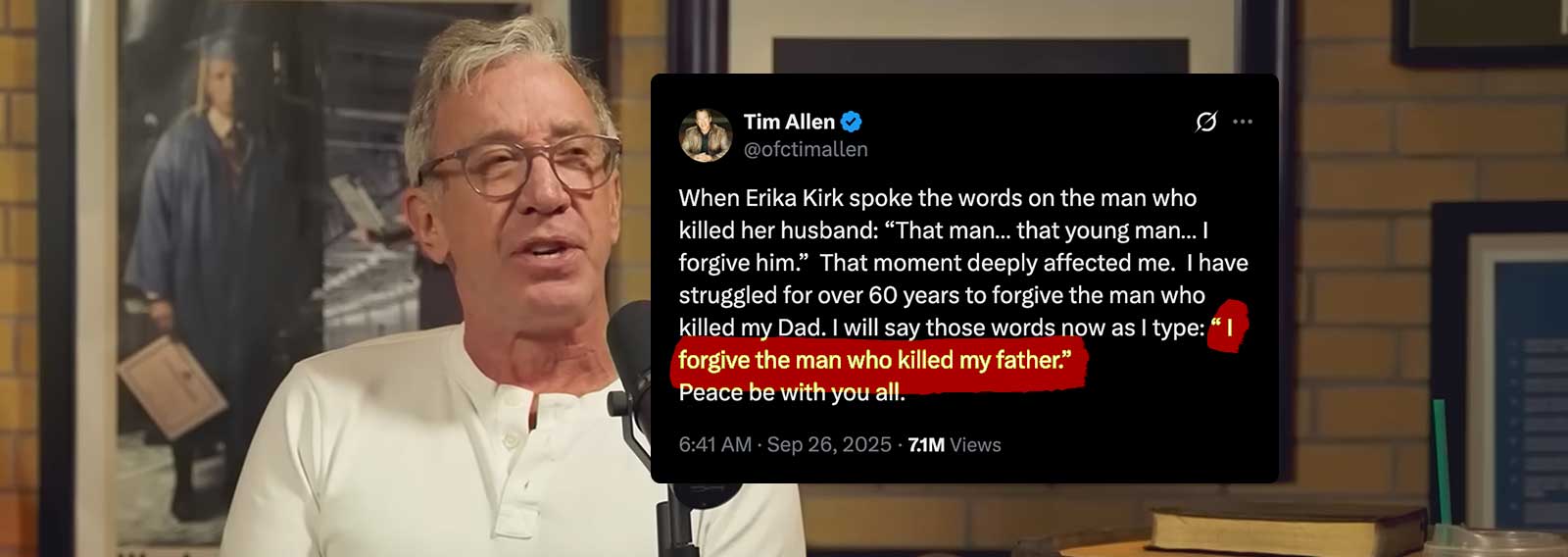
On X, Allen stated,
“When Erika Kirk spoke the words on the man who killed her husband: “That man… that young man… I forgive him.” That moment deeply affected me.
“I have struggled for over 60 years to forgive the man who killed my Dad.
“I will say those words now as I type: “ I forgive the man who killed my father.”
“Peace be with you all.”
5 months ago, Allen, 71, told Mike Rowe his “dad was killed by a drunk driver, and did Allen’s mother’s arms.”
Tim Allen was only 11.
At the time, Allen said, none of it made sense.
“He was a great dad, the love of my life. The questions never stopped, the pain of it never stopped. The discomfort never stopped.
“For many years,” Allen said that “he didn’t care,” although it put him on a path to asking questions that never “genuinely got answered.”
Kirk’s forgiveness is contagious because the paradox of forgiveness is God’s business.
This paradox took me to my father’s deathbed, when he deserved only distance.
This is grace. It doesn’t just move through us; it moves us.
As it is with the gift of faith, so it is with the power to forgive. The ability only comes from us being acted upon by an outside force.
As Elon Musk once told Jordan Peterson,
“For a while, he thought turning the other cheek was really a weak thing.”
“But this notion of forgiveness is important. I think it’s essential because if you don’t forgive, then an eye for an eye makes everyone blind.”
“I do believe that the teachings of Jesus are good and wise. There’s tremendous wisdom in turning the other cheek.”
He said as much again by quoting from Matthew 6:12 on the day of Charlie Kirk’s memorial.
To which Ayaan Ali Hirsi responded,
“[Forgiveness] is the core of Western Civilisation and the core of America.”
The ex-Muslim and former atheist, then added,
“There is no text as True, concise, humane and timeless as the Lord’s Prayer.
“Throw it away, and it all starts to crumble down. Embrace it and watch the Restoration happen. Amen.”
This is grace. God first forgives us.
Present in the pain, God’s paradox of forgiveness is His revolt against darkness and our disordered world.
R.C Sproul said when talking about faith and reason, “We don’t just believe in God, we believe God.”
We either take God at His Word, or we don’t.
All it takes is a response: the hearing of and surrender to His Word, His presence, and His promises; the fulfilment, and future fulfilment of them.
Forgiveness taken up takes the form of prayer.
So intense is the pain that all words fail. All that’s left to give to God is emotional vomit: a Sancits Cry De Profundis.
A guttural reach for God uttered in despair, because the pain that comes from loss is, as the cliché goes, “too hard to bear.”
The good news is, God doesn’t leave us with “a broken and contrite heart.” (Psalm 51:17)
Nor does He despise one.
By, though, in and with Christ, God’s forgiveness teaches us to exhale dust and inhale grace.
The paradox of forgiveness is not about forgetting; it’s about learning to breathe again.