

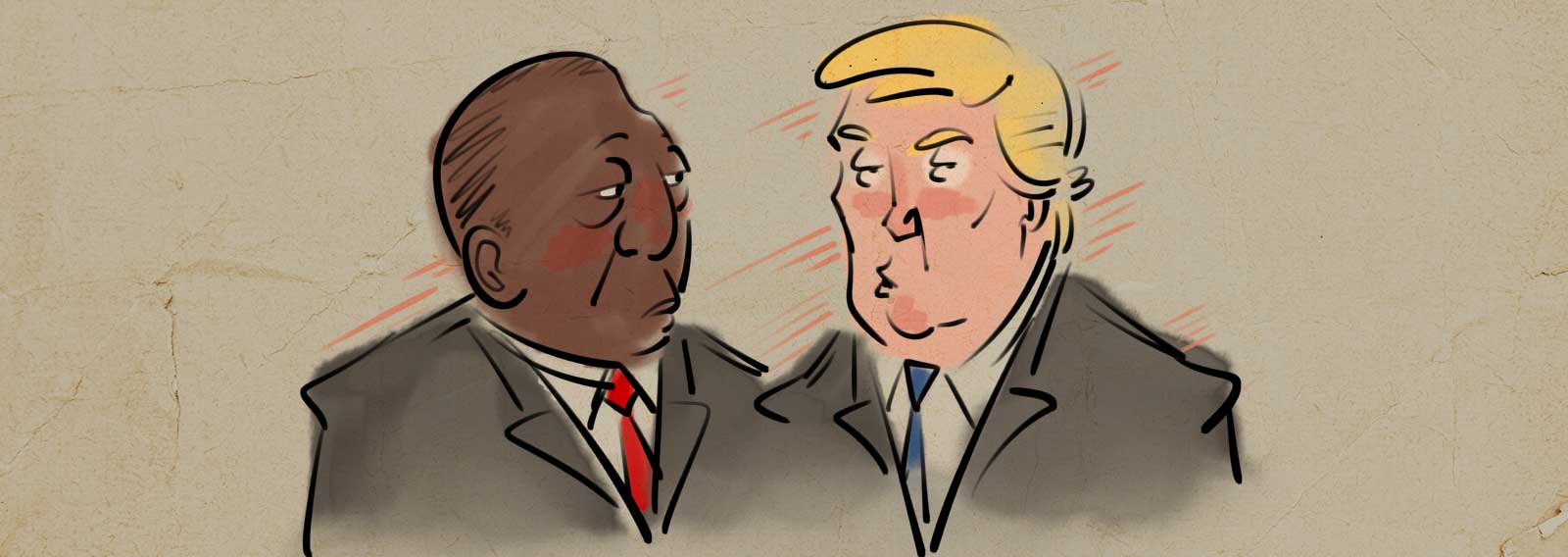
In the gilded cage of the White House, on a crisp morning in May 2025, President Donald Trump performs an act of audacity that is as bracing as it is divisive. Seated across from South African President Cyril Ramaphosa, he unfurls what he calls evidence of a deliberate genocide against white South Africans—a charge as incendiary as it is unorthodox in the normally staid world of diplomacy.
The room crackles with tension, not least because Elon Musk, the South African-born titan of X and a man whose tweets have helped to fan these flames, watches from the sidelines, his presence a tacit endorsement of Trump’s gambit. As reported by NBC News on 22 May 2025, Trump cues a montage of videos: clips of Economic Freedom Fighters (EFF) supporters chanting “Kill the Boer,” grainy footage of farm attacks, and fiery speeches from Julius Malema, the EFF’s demagogue-in-chief.
Ramaphosa, ever the diplomat, deflects, insisting these are not state policy, that South Africa is no slaughterhouse for its white minority. To the onlooking media elites, the exchange is a diplomatic trainwreck, a clash of Trump’s unfiltered bravado and Ramaphosa’s measured restraint. To those with clearer vision, in its very recklessness, Trump’s stand is a rare act of courage, a defiance of the media’s reflex to shield South Africa’s post-apartheid regime from scrutiny, no matter how troubling its excesses.
This moment lays bare a truth that demands unflinching examination: nations and peoples must hold one another to account, not out of spite but as a moral imperative. Without such guardrails, the slide into barbarity is not just possible—it is inevitable, as we’re also currently seeing in Israel’s unrestrained war of annihilation against its neighbours.
South Africa’s Expropriation Act of 2024, which permits land seizures without compensation in certain cases, has stoked fears among white farmers, who control roughly 70% of commercial farmland while comprising just 7% of the population. Farm attacks are real and brutal, carried out by Black South Africans, many of whom may have had military training or support, as their use of sophisticated portable mobile phone jammers indicates. There were 44 farm murders in 2024, eight of them farmers, according to police statistics. The EFF, with 9.5% of the parliamentary vote, has been filmed singing “Kill the Boer,” a song deemed protected speech in 2022 but whose optics are a Molotov cocktail in a nation scarred by racial wounds. These are not the fever dreams of a MAGA rally but facts that demand reckoning, however inconvenient they may be to the West’s post-apartheid romance with the new South Africa.
To speak of these things, however, is to invite the wrath of the liberal West’s progressive gatekeepers, who brand any critique of a black-led government as racism, a scarlet letter to silence dissent. Herein lies the cowardice of white liberals, those sanctimonious arbiters of virtue who clutch their pearls at Trump’s audacity while refusing to glance at South Africa’s manifest injustices.
To criticise black politicians or black-majority nations is not an act of racial animus; it is the very essence of equality. To hold them to the same standards we demand of any society aspiring to justice is to treat them as peers, not as fragile wards exempt from scrutiny. If we avert our eyes from their lapses—whether out of guilt, fear, or some patronising impulse to “protect” them—we do not uplift them; we diminish them. We consign them to a lesser plane, unfit for the rigours of true accountability. This is the scandal of our time: a liberalism so spineless, so shackled to its own historical shame, that it cannot bear to speak truth to power when that power is wielded by those it deems eternally oppressed.
Elon Musk, in a 2023 tweet, declared, “They are openly pushing for genocide of white people in South Africa,” linking to a video of EFF supporters chanting “Kill the Boer.” On 13 May 2025, he doubled down, posting, “Very few people know that there is a major political party in South Africa that is actively promoting white genocide.” These are not the words of a cautious scholar, but they resonate because they touch on a reality—racial tension, unresolved historical grievances—that cannot be wished away with platitudes.
Trump’s courage lies not in the precision of his terminology but in his willingness to broach this subject at all, knowing the denigration it would draw from a media that sees no fault in South Africa’s post-apartheid project. When he welcomed 59 white South Africans as refugees on 12 May 2025, citing genocide, the backlash was as swift as it was predictable. The Atlantic and The Guardian excoriated him for pandering to white nationalist tropes, invoking the spectre of white replacement theory.
Trump’s critics operate not from evidence but from ideology, a worldview that forbids any critical examination of black-led governments. Theirs is a political stance, not a factual one, rooted in the dogma that to question South Africa’s policies is to align with AfriForum, the Afrikaner lobby, or worse, with the likes of Nick Fuentes or other white nationalists who hailed Musk’s 2023 tweet as a triumph. Trump, for all his flaws, saw this coming and pressed on, a rare act of defiance against a media that prefers fairy tales of reconciliation to the messy truth of South Africa’s present.
This is the crux of the matter: the fear of being tainted by association has strangled honest discourse. To hold South Africa accountable is not to endorse Trump’s hyperbole or Musk’s provocations. It is to insist that no nation, regardless of its history, is above reproach. Nations are not abstractions; they are human constructs, prone to error and excess. To exempt South Africa from criticism because of its apartheid past is to deny its agency, to treat it as a perpetual victim rather than a sovereign state capable of shaping its destiny.
The same applies to its leaders. Cyril Ramaphosa, a figure of some gravitas, has dismissed claims of white persecution as a “completely false narrative,” as he did in his 25 March 2025 address. Yet his government’s Expropriation Act, however legally defensible, has fuelled perceptions of racial targeting, particularly when paired with Malema’s calls to “take back the land.” To ignore this is not diplomacy; it is evasion. To critique it is not racism; it is duty. Trump’s bravery lies in naming this, in forcing a conversation the West would rather bury beneath layers of sanctimony.
The necessity of mutual accountability extends far beyond South Africa to the very architecture of international relations. Nations, like individuals, require external checks to prevent descent into chaos or tyranny. The West, for all its imperfections, has forged mechanisms—however flawed—to curb its own excesses: a free press, independent courts, and the crucible of democratic debate. Developing nations, many still wrestling with the legacies of colonialism or the fragility of nascent institutions, often lack such safeguards.
This is not a racial defect but a historical one, a product of time and circumstance. Yet if we in the first world refuse to call out their missteps—whether from guilt, fear, or a misguided belief in cultural relativism—we abandon them to their worst impulses. We become complicit in their stagnation, ensuring they remain forever on the margins of the freedoms we take for granted. Trump’s White House gambit, however clumsy, is a refusal to let South Africa slide unremarked, a recognition that silence is not kindness but betrayal.
Apartheid’s legacy, which concentrated wealth and land in white hands, was a stain that demanded redress. The ANC’s push to correct this, through measures like the Expropriation Act, risks deterring investors, destabilising agriculture, and inflaming racial tensions. Critics like Ruth Law of the University of Western Cape argue it merely clarifies existing powers, but the optics—amplified by Malema’s rhetoric—are a gift to those crying “genocide.” A true ally would not cheer this policy blindly but would urge caution, transparency, and dialogue to prevent it from becoming a flashpoint. This is what accountability looks like: not condemnation for its own sake, but a demand for excellence, rooted in the belief that South Africa can transcend its divisions. Trump’s willingness to raise this, despite the media’s inevitable howls, is a rare act of statesmanship, a rejection of the West’s tendency to coddle nations it deems historically wronged.
Musk’s role in this drama is both illuminating and vexing. His tweets tap into a broader unease about policies rightly perceived as punitive to non-black groups. His influence, magnified by X, has mainstreamed these concerns, forcing a debate the West elites would rather sidestep.
The white liberal establishment, by contrast, clings to its narrative with a zeal that is almost theological. When Trump cut US aid to South Africa in February 2025, citing land policies and South Africa’s ICJ case against Israel, outlets like PBS and The New York Times framed it as a capitulation to white supremacist myths. When 59 Afrikaners arrived at Dulles Airport as refugees, greeted by Deputy Secretary of State Christopher Landau, the Episcopal Church and Senator Jeanne Shaheen decried it as preferential treatment for a politically favoured group. Thankfully, nobody really attends that church anymore.
This brings us to the heart of the matter: the obligation to speak plainly, even at great cost. If we believe in equality—not as a slogan but as a principle—then we must treat black politicians and black-majority nations with the same rigour we apply to their white counterparts. To do less is to patronise, to imply they are too delicate for criticism or too sacred for scrutiny. This is the soft bigotry of low expectations, dressed in the garb of compassion. When Ramaphosa denies persecution of whites, he deserves to be challenged, not because he is black but because he is a leader whose policies shape lives. When the EFF sings “Kill the Boer,” it warrants condemnation, not because it targets whites but because it poisons a nation already raw with division. To stay silent is to abdicate our duty, to let South Africa drift toward the kind of barbarity that festers in the absence of accountability. Trump’s courage is in refusing that silence, in daring to speak when the media’s chorus demands fealty to a sanitised narrative.
And barbarity is not too harsh a term. South Africa, for all its strides since 1994, stands on a precipice. Its economy, Africa’s largest, is hobbled by unemployment and inequality. Its crime rate, among the world’s highest, fuels perceptions of chaos, even if it does not discriminate by race. The EFF’s rhetoric, however symbolic, risks normalising violence in a society where trust is already threadbare. If these trends go unchecked—if land reform becomes a vehicle for vengeance, if political discourse descends into racial score-settling—South Africa will not join the first world. It will not share in the freedoms of stable governance, economic opportunity, or social cohesion that define advanced societies. It will remain mired in grievance and dysfunction, a warning of what happens when noble aims are not tempered by discipline and foresight. Trump’s White House spectacle, for all its flaws, is a clarion call to avert this fate, a refusal to let South Africa’s promise be squandered.
The West, for its part, must abandon its delusions. The white liberal fantasy of a post-racial utopia, where criticism of black-led governments is taboo, is not just naive—it is perilous. It assumes that history’s victims are inherently virtuous, their policies beyond reproach. This is not equality; it is a new segregation, where black nations are shielded from the scrutiny that sharpens and strengthens. If we truly wish to see South Africa—and other developing nations—rise, we must hold them to the same standards we demand of ourselves. We must call out their excesses, not to humiliate but to elevate, to ensure they build institutions that endure rather than collapse under the weight of unaddressed flaws. Trump’s bravery, in the face of a media eager to caricature him, is a challenge to this complacency, a demand that we engage with South Africa’s reality rather than its myth.
The White House confrontation, for all its absurdity, is a distorted reflection of this truth. Trump’s genocide claims force us to confront what we would rather ignore: South Africa’s unresolved tensions, its flirtations with policies that could unravel its fragile progress. Musk’s tweets, however inflammatory, amplify a debate that cannot be suppressed. The white liberals who cry “racism” at every critique are not defending justice; they are defending their own comfort, their refusal to grapple with a world that defies their dogma.
If we fail to hold South Africa accountable—if we let its leaders veer into extremism or its policies slide into retribution—we condemn it to a future of strife, not freedom. And in doing so, we betray the equality we profess, ensuring that the first world’s liberties remain a distant mirage for those still struggling to escape the shadows of their past.