

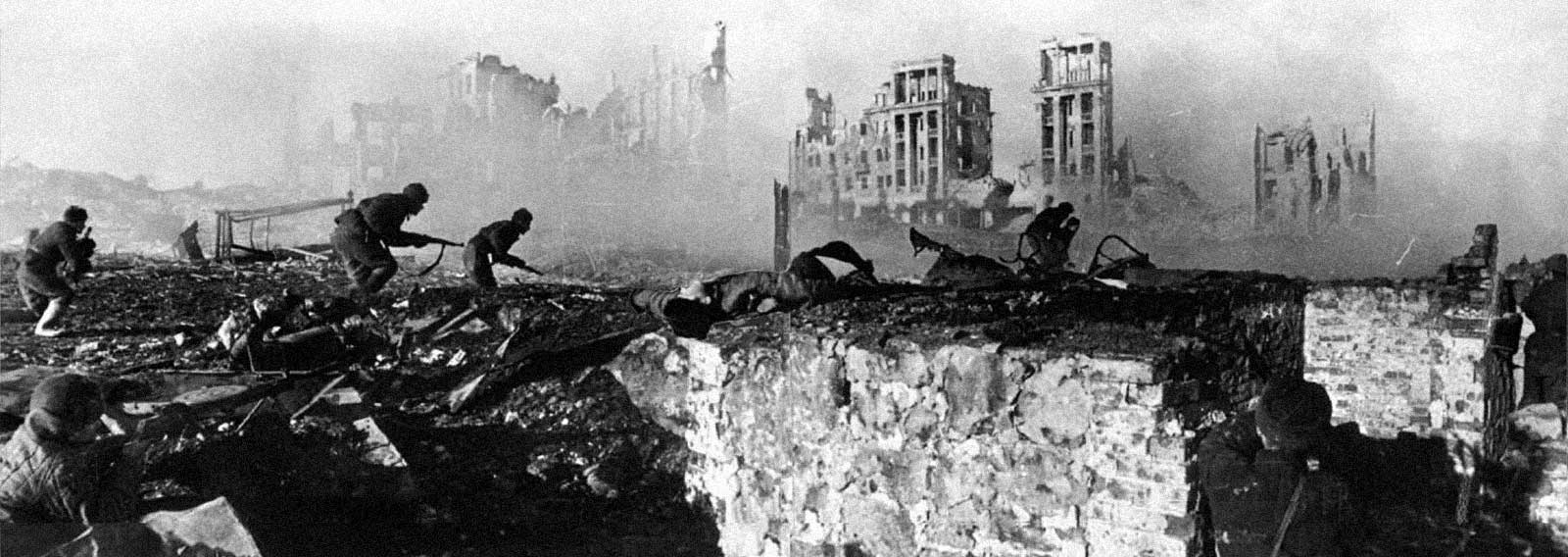
When you speak to the average person about World War 2, they will generally think in these terms: this was a war that Churchill was desperate to win against the AXIS powers, he and Britain stood alone against the rising tides of evil, France was too weak to properly contribute, and America saved Europe’s butt from the Nazis. That’s the simplistic view that many Westerners have.
This perspective is so common in the West that it pervades our popular culture, as this example from The Simpsons shows:
But this view of World War 2 is a very incomplete picture. Many Westerners will know that America and Britain allied with the Soviets to beat the Axis of Italy, Germany and Japan and their satellites, but very few realise just how much Eurasia, including Russia, contributed to the war effort.
“Likewise, the dominant Western narrative of WWII increasingly frames the conflict as a stark moral battle between good and evil. As a result, there is a growing reluctance to fully acknowledge the pivotal roles that Russia and China played in the defeat of Nazi Germany and militarist Japan…
…Instead, the predominant view in most Western countries credits the US as the primary force behind victory, along with limited support from other allies. This reading of WWII has nothing to do with reality, but it nicely fits the now popular Manichean interpretation of world politics.
Another typical distortion of history is the selective portrayal of the victims of the war, often shaped by a distinctly Eurocentric perspective. Much attention is given to the atrocities endured by Europeans under Nazi occupation or by Europeans in Asia at the hands of the Japanese, while the immense suffering of non-European populations frequently receives far less recognition.
Every human life is of equal value, and all victims deserve empathy. Even those who served in the German and Japanese armed forces during WWII should not be indiscriminately labeled as criminals; the notion of “collective guilt” must not override the principle of individual responsibility for verifiable war crimes.
However, it is often overlooked in contemporary Western discourse that the Soviet Union and China suffered the heaviest human cost of WWII – with casualties reaching 27 million and 35 million, respectively. A significant portion of these losses were civilians, and the scale and brutality of wartime atrocities committed on Soviet and Chinese territories far exceeded those experienced in most other regions.
Contemporary politics inevitably shapes how we interpret the past, as people often seek historical narratives that align with their present-day beliefs and agendas. Yet history should be approached with integrity, not as a tool to justify current political positions. This is not about defending national pride or preserving comforting myths; every nation, regardless of size or wealth, carries both moments of honor and episodes of regret in its historical journey. A balanced national narrative includes both triumphs and failures.”[1]
This is very important to meditate on because the Western view of WW2 is still basically shaped by the propaganda that was pumped out by Western leaders in the West during the war, and which arguably never went away. The idea that the righteous West was fighting against the evil Axis.
There is no doubt that the Axis powers committed atrocities. Some seek to deny this, but this is simply an overcorrection. The truth is that the war brutalised all who were involved, and as the war progressed, both sides used increasingly inhumane tactics, which culminated in Allied war crimes like the bombing of civilian Dresden and the Atomic attacks on Japan, among many others. Therefore, true crimes against humanity are found on both sides of the war.
Part of the problem with the way we remember ourselves in this war is that not only are the war crimes of our side downplayed massively, but they are often also used to justify ongoing war crimes today. It is not uncommon to see people saying that what we did in Dresden justifies what Israel is doing today in Gaza. How we remember WW2 really makes a difference in how our nations think about justice and just war. And the West’s skewed perspectives on this war have caused our leaders to justify all sorts of ill-advised and inhuman wars across the world since 1945. The “we were righteous in our actions” narrative about the West has created a self-righteous approach to aggression against many other nations.
As Kurtonov says, “This is not about defending national pride or preserving comforting myths; every nation, regardless of size or wealth, carries both moments of honour and episodes of regret in its historical journey. A balanced national narrative includes both triumphs and failures.” Every nation should be willing to celebrate its moments of honour, but also mourn and repent for its moments of regret. But when history is remembered in a caricatured way, where we are always the good guys and we were always fighting cartoon villains, then not only do we not learn from the past, we repeat our mistakes again and again and again, and feel justified in doing so.
The destabilisation of the Middle East is a good example of this. The West has sought to tame the Middle East, alongside Israel, like it did Germany. But the problem is that the Middle Eastern conflict zone is very different, and our world is now very different. Again and again, Western armies have scorned the capabilities of their Middle Eastern opponents and suffered humiliation as a result. We continually make the fatal mistake Sun Tzu said to never make; we believed our own propaganda about ourselves, and therefore did not know ourselves, and we so mocked our enemies that we did not know them either. But if you do not know yourself or your enemies, you cannot win. Hence, we keep losing against opponents that are described as ragtag and worse.
The West does not have the capacity to achieve this goal of taming the Middle East, nor do we have a moral right to subjugate the region. Yet you will hear people continually argue that we fought a just war in WW2, that WE won, and we pacified Europe, so maybe this is justified today? But what if our side was not as righteous as we like to think or are often trained to remember? And what if our side was not as powerful as we have been trained to think, but was more reliant on its Eurasian allies than we like to admit? This undermines a lot of the argument for what the West is doing in the Middle East today. Does it not?
This is not about beating ourselves up and buying into nonsense white guilt or anything like that, either. This is more about simply recognising that evil exists in all nations, and evil bears certain bad fruit; we should look for that fruit to identify where evil is in action. Do not judge a nation by its rhetoric but by its actions. Which ever side you are on, evil is still evil, and to respond to evil with evil simply lowers you to the level of those you are seeking to resist.
As Christians, we have a duty to be honest about our past, so that we are better able to be the conscience of society going into the future. I personally think allying with Communism to fight Nazism was a mistake, and the decline of the West in the 20th century proves that. We won the war but lost our souls as nations. We should have let those two beasts combat each other instead.
But there is another lesson that we learn from examining WW2 more honestly. And that is that Russia is a much harder nut to crack than people realise. In the minds of many Westerners, it was the American army that won World War 2. But Russia mobilised more men and lost more men on the eastern front than did the allies on the western front, where the US and Britain were fighting Germany. The Russians fielded more soldiers and killed more German soldiers. America’s efforts were incredible, of course, as were the other Western Allies, but Russia took the brunt of Germany’s war machine. Perhaps too many Western elites have built their view of WW2 on Hollywood movies, which focus on the Western efforts, and this is why they are foolishly escalating a war with a nation that neither they nor we are equipped to beat.
Even Australia’s Prime Minister has said he is open to sending troops to Ukraine as part of a peacekeeping force,
“The Prime Minister today told media Australia “stands ready to assist” President Volodymyr Zelenskyy if a call for help against Russian advances was made. “Our position on Ukraine is very clear. We stand with the people of Ukraine and we stand with President Zelenskyy,” the PM said at a press conference in Sydney.”
I think it is entirely possible he does not really understand just how stupid a move this would be, and this is in part because of a flawed Eurocentric view of how WW2 was won. People forget just how much Russia was involved in this victory, and they also forget just how much the US and other allies were not interested in heeding Churchill’s calls to continue against Soviet Russia in 1945. Because they knew it was too much of a risk. They knew how tough it would be to face Russia even then.
Sometimes bad history is not just a point of error, but a point of danger. The West has severely overestimated its capabilities since WW2 ended. We were ground to a halt by Chinese troops in Korea. We lost the will to fight because of an intractable enemy in Vietnam. We have spent trillions seeking to tame a Middle East that cannot be tamed. We have lost many wars in the region as a result, with one notable exception in the 1990s. And we have declined in relative strength to the rest of the world in the meantime.
Not everything we know about World War 2 is wrong, but the overarching narrative of the US victory, helping the plucky and stoic British win, is incomplete. A greater evaluation of our reliance on Eurasian allies to win that war might just humble us enough to realise the danger that the West is in today. Russia is far more formidable than most Westerners realise, and the US and Europe are far less capable than most people believe. Propaganda is part of the reason why so many people are surprised by this.