

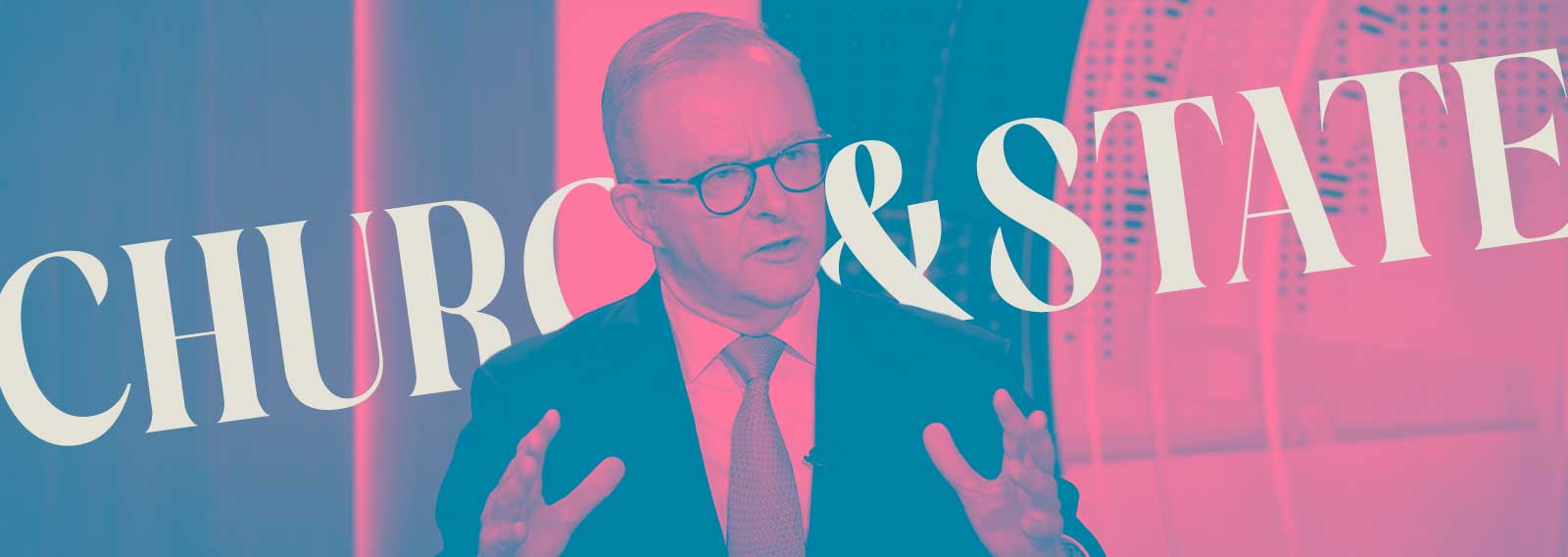
Australian Prime Minister Anthony Albanese has said he chose not to place his hand on the Bible during his swearing-in ceremony, citing his belief in the separation of church and state. In a recent interview on Inside Politics for The Sydney Morning Herald and The Age, Albanese said he opted for a personal affirmation rather than a Christian oath because he represents Australians of “every faith, and no faith.”
“I believe in the separation between church and state,” the Prime Minister said. “So, I chose today—as I’ve always chosen—to do an affirmation because I think that as the Australian Prime Minister, I represent people of every faith, and no faith.
“So, that for me—that’s a personal decision,” he said. “Other people who swear on the Bible—or the Quran, in Anne Aly’s case—is perfectly up to them. It’s a personal choice, but for me, that’s a personal choice that I make and have made.”
Prime Minister Anthony Albanese says he chose not to place his hand on the Bible during his swearing-in, stating that he represents "people of every faith and no faith." pic.twitter.com/IMLYgfDqWo
— Australians vs. The Agenda (@ausvstheagenda) May 14, 2025
However, the Prime Minister’s comments betray a complete misunderstanding of the principle of church-state separation. Sidelining Christianity does not equate to religious neutrality. In fact, in his supposed attempt to appear impartial and avoid conflating religion with politics, Albanese inadvertently does the exact opposite, because religion is inescapable, and religious neutrality is a myth.
Underlying the Prime Minister’s misguided assertion is the assumption that the “secularism” he embraces is not itself a religious commitment. Rather, it is portrayed as a neutral ground from which all religious convictions can be assessed through an ostensibly impartial and areligious lens. This, however, is the fallacy of the middle ground—as even the claim to have no faith in any higher authority is itself a religious assertion. Religion, in one form or another, is inescapable.
The moment someone defines moral “oughts” and “ought nots”—judging actions as either good or bad, moral or immoral—they are articulating a religious conviction, even if they deny any affiliation or association with a recognised religion. To assert a moral framework, especially in a position of political authority that involves legislating and enforcing such judgements, is to presuppose beliefs about human nature, the universe we inhabit, our purpose in life, and ultimately God. It ventures beyond there mere material realm of how things are, into the inherently religious realm of how things ought to be.
Whether or not the Prime Minister professes belief in a deity, by adopting an applying a moral system to others, he is presupposing something about God—whether he exists or whether He doesn’t; how He does or does not relate to the world, and how humans ought or ought not to respond to Him. One need not explicitly invoke God for a belief to be inherently religious. It is enough to complete the sentence, “God is…” Even if the answer is “irrelevant” or “nonexistent,” that, too, is an inherently religious conviction.
In the end, every political and ideological system is governed by a reigning theos—or god. This includes systems that claim religious neutrality. As Cornelius Van Til observed, to identify the god of any system, one needs only locate its source of law or highest court of appeals. The source of ultimate law is the system’s god. The question then, is not whether we will be governed by a theocracy, but which theocracy will prevail.
In Albanese’s case, the refusal to acknowledge the authority of the Bible is itself a religious assertion—namely, that the ultimate throne of the universe is vacant. The final moral authority then is measured by the largest stick in the schoolyard. By declining to swear on the Bible, the Prime Minister is effectively declaring that he will not be bound by the moral constraints of Christianity, but will govern according to what he personally deems right. As he puts it, it is simply “a personal choice.”
As such, Albanese’s brand of “secularism” is not opposed to religion per se; it is not areligious or religiously neutral, as he would insinuate. Rather, it is opposed to a specific religion that affirms the sovereignty of God over human beings and their institutions. Within this secular framework, there is still very much a theology to be preserved and a moral order to be enforced—it simply replaced the law of God with the law of man—or one man in particular: Albanese.
In essence, it is the religious system of Humanism that substitutes God with man and the church with the state. And it is a deeply religious system. As secular humanist, John Dewey, wrote in The Humanist Manifesto I:
“Religious humanists regard the universe as self-existing and not created… Humanism asserts that the nature of the universe depicted by modern science makes unacceptable any supernatural or cosmic guarantees of human values… Religion must formulate its hopes and plans in the light of the scientific spirit and method… Man is at last becoming aware that he alone is responsible for the realization of the world of his dreams, that he has within himself the power for its achievement… While this age does owe a vast debt to the traditional religions, it is none the less obvious that any religion that could hope to be synthesizing and dynamic force for today must be shaped for the needs of this age. To establish a religion is a major necessity for the present…”
As such, secular humanism is not opposed to religion—it is an alternative religion, the fruits of which are rotten to the core. Historically, such systems have repeatedly led to some of the gravest atrocities committed by humans against their fellow man. The reason for this is obvious: When the so-called “areligious” state refuses to acknowledge any authority above itself, it inevitably becomes a law unto itself. Abandon Christianity as the foundation for government and law, and you also abandon the principle that governing authorities must operate within the moral limits prescribed by God. When man becomes the ultimate arbiter of truth and morality, human rights are no longer inalienable gifts from God, but privileges subject to the arbitrary will of the state.
Let’s not miss the irony here: The Prime Minister refused to be sworn in on the Bible in an effort to avoid conflating church and state. Yet such a conflation does not occur only when clergy intrude upon civil governance—it occurs equally when civil authorities claim spiritual or moral authority for themselves. By feigning “neutrality,” Albanese is not appealing to all Australians or embracing all faiths—he is positioning himself as the arbiter of truth and morality, thereby conflating the civil authority with that of the church. In doing so, the Prime Minister effectively clears the path for any would-be tyrant who acknowledges no king above Caesar and no law above the state.
Let’s be clear: The only one advocating for the conflation of church and state here is Anthony Albanese. When a civil authority takes an oath on the Bible, they are not thereby signalling the imposition of an ecclesiocracy, where clergy rule in place of civil leaders. Rather, swearing on the Bible is a symbolic and solemn acknowledgment, fundamental to Western governments, that the civil authorities will govern within a higher moral framework than their own personal ambitions, opinions, and preferences. It is a recognition that all authority is delegated authority, not absolute. It is a public admission that the civil authority is accountable to a law beyond itself.
In truth, it is this very acknowledgment of a higher authority that has allowed Western civilisation to flourish as a beacon of freedom, justice, prosperity, and moral clarity. The historic—and profoundly biblical—distinction between church and state was never about erasing God from politics. Rather, it upheld the unique and complementary roles of each sphere under the ultimate sovereignty of God. This framework did not confuse the responsibilities of clergy and civil leaders; it recognised that both are accountable to a law beyond themselves—a moral order not created by man, but revealed by God.
By refusing to swear on the Bible—and thereby rejecting the symbolic acknowledgment of his God-given limitations—the Prime Minister ironically does precisely what he claims to avoid: he conflates church and state by absorbing spiritual and moral authority into his own office. In denying the authority of Christ as King, he places himself in the role of ultimate moral arbiter, effectively establishing a religion of self. Under the guise of separating church and state, he collapses the very distinction by presuming to occupy both spheres.
The state—and certainly not Anthony Albanese—is not the arbiter of moral oughts and ought-nots. That role belongs to Christ alone. By reducing Christianity to merely one among many competing and contradictory options and equating the Bible with the Quran as interchangeable, the Prime Minister assumes the place of the church, and fails to recognise the essential distinction between church and state.
As such, by rejecting the foundational role of God’s law in governance, he does not achieve neutrality but assumes the role of ultimate moral arbiter himself—effectively merging the authority of church and state into one. True separation of church and state does not mean erasing God’s sovereignty from public life; rather, it honours the distinct yet complementary roles each sphere plays under His ultimate rule.
Rejecting God’s law as the foundation of governance does not create neutrality; it places man’s arbitrary will above all else. True separation of powers respects the distinct yet complementary spheres of church and state under God’s sovereign rule. For any society committed to justice, freedom, and moral clarity, acknowledging Christ’s kingship is not a religious imposition but a recognition that no man holds absolute power over another. It is the recognition the rights of the governed are granted by God, not the state. Anything less is a precarious path toward moral confusion and tyranny.