

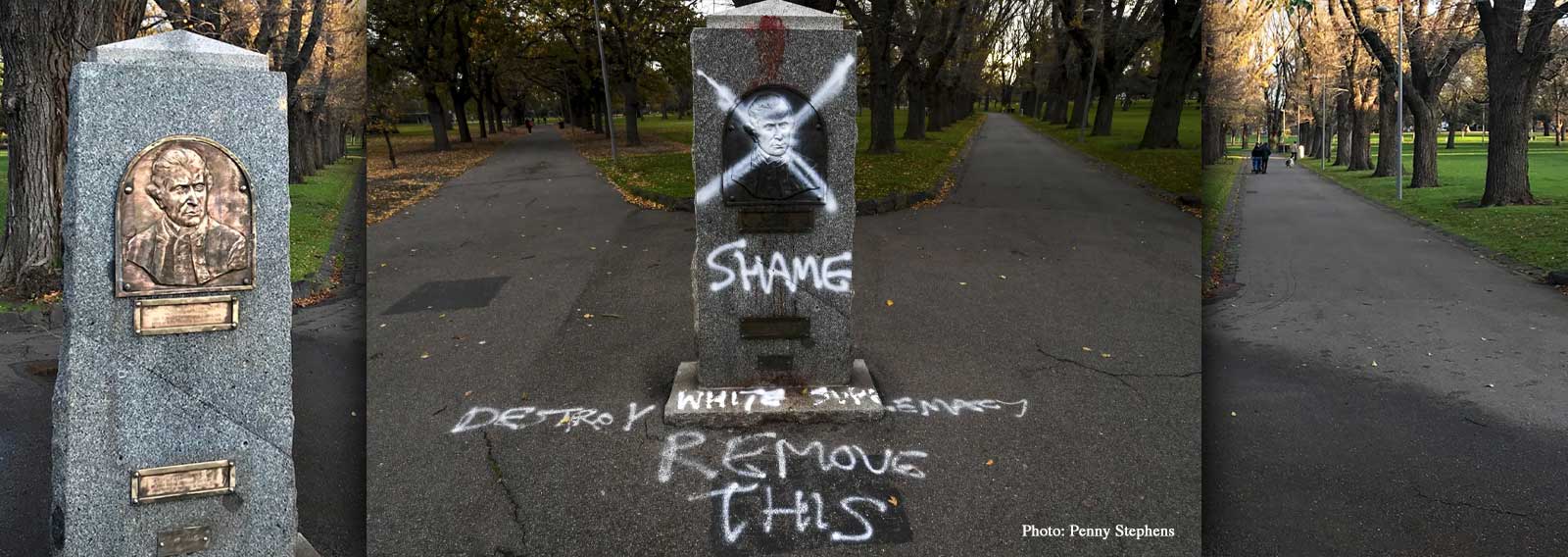
A memorial to Captain James Cook has been permanently removed from public display following repeated acts of vandalism, after the City of Yarra council voted this week against restoring the statue.
The monument, which previously stood at the entrance to Edinburgh Gardens in Melbourne’s inner north, was graffitied with the words “Cook the colony” and knocked over on January 26, Australia Day. It has since been held in council storage.
In a report presented to the council, officials described the memorial as “contentious within the community,” claiming “Cook is a contested figure in relation to First Peoples.” The report further stated that the memorial was “of little or no significance,” citing its “poor condition and structural integrity,” and estimated that restoration would cost approximately $15,000.
Yarra Mayor Stephen Jolly defended the decision on ABC Melbourne, stating, “It’s a waste of ratepayers’ money.” Jolly added that retaining the statue would likely require additional security and lighting, saying, “I just don’t think the locals want that.”
The memorial was originally donated in 1937 by local foundry owner J.A. Heyman to the former City of Fitzroy. In 1985, it was temporarily moved to the Melbourne Maritime Museum, before returning to Edinburgh Gardens.
The repeated vandalism of historical monuments in Australia, particularly those commemorating colonial-era figures such as Captain James Cook, marks a disturbing rise in anti-historical sentiment masquerading as activism. These acts are not legitimate expressions of democratic dissent but rather criminal offences that undermine the rule of law, disrupt public order, and erode the foundations of civic dialogue.
More troubling still is the response from local authorities. Instead of defending public heritage and upholding legal accountability, many councils have opted to remove monuments permanently following repeated acts of vandalism. This response effectively rewards unlawful behaviour, sending a message that persistent defacement will be met not with enforcement, but with capitulation. Such decisions risk setting a precedent in which historical preservation is subordinated to intimidation, emboldening further acts of vandalism and weakening institutional resolve.
This approach not only fails to deter future offences but also undermines the integrity of democratic processes. It replaces open debate and lawful change with coercion, encouraging a climate in which history is rewritten through force rather than informed engagement. Public authorities have a responsibility to preserve monuments as sites of historical reflection and education, not to yield them to those unwilling to participate in constructive discourse.
At the same time, the Australian government allocates substantial funding to protect and support a range of “vulnerable” and “minority groups.” These include Indigenous Australians, through truth-telling initiatives and Indigenous-led programs; Jewish and Muslim communities, with funding for antisemitism and Islamophobia prevention, security at places of worship, and interfaith dialogue; LGBTQ+ individuals, through mental health and inclusion programs; people with disabilities, via the National Disability Insurance Scheme and advocacy initiatives; women, with investments in gender equality and violence prevention; and multicultural communities, supported by anti-racism campaigns and cultural grants. These programs aim to promote social inclusion, combat discrimination, and safeguard cultural heritage across the nation.
Yet, in this supposed commitment to diversity and protection, one group is notably absent: Anglo-Celtic Christians. While nearly every ethnic and religious group receives targeted support to counter hatred and preserve its heritage, this foundational demographic is increasingly excluded from such considerations. This obvious disparity raises important questions about the consistency and fairness of multicultural policy in Australia.
A spokesperson for the British Australian Community (BAC) criticised the council’s decision in comments to Caldron Pool, saying:
“Yarra Council, led by hard line Socialist Stephen Jolly has refused to replace the Captain Cook statue which was vandalised in Edinburgh Gardens in Melbourne’s Inner North a year ago, claiming it would cost too much.
“This appalling decision has sent a message to hate filled Anglophobic vandals everywhere that by destroying our precious monuments, they can remove public displays of British heritage, history and culture. This surely is their goal and Yarra Council has just handed them a major victory.
“The British Australian Community rejects the blatant two-tier standards. When other communities have their property damaged, councils and governments bend over backwards to replace it no matter the cost and every effort is made to find the perpetrators.
Australians should realise that there is genuine hatred of our British origins by some extremists. Yarra Council’s decision demonstrates, once again, that the Anglo Celtic community is excluded from the multicultural system. Our ethnic interests – and only ours – are treated with contempt.“Yarra’s Mayor should realise that hatred of Australia’s founding ethnic group is real and will respond only to firm treatment. In such situations, appeasement does not work. The enemies of Australia’s core identity must be made to understand that they can never win.
“Security and surveillance measures should be increased and councils and Governments around Australia should commit to replacing every vandalised statue with two or three more to be placed in prominent positions. The haters of Australia’s history should understand that they cannot rob the country of its heroes.
“Perhaps then, these vandals will see that the colony, our historic nation, will never fall.”
The decision adds to a growing trend in which monuments linked to Australia’s colonial past are increasingly targeted and removed, under pressure. In response, the BAC has launched the “Name Back” campaign, a new initiative aimed at safeguarding Australia’s Anglo-Celtic heritage from what it describes as a “rewriting of history” and an “assault on our Anglo-Celtic foundations.” Supported by The English-Speaking Union (Victoria Branch), the campaign seeks to protect historical names, statues, and monuments from erasure and vandalism, calling on Australians to take action.
For more information on the “Name Back” campaign and how to get involved, visit the British Australian Community website.