

In the article titled, To Christians arguing ‘no’ on marriage equality: the Bible is not decisive, Robyn J. Whitaker suggests the story of Sodom and Gomorrah, as recorded in Genesis 19, has “nothing to say about homosexuality.” The destruction of the two cities is rather attributed to “sexual violence and rape.” But is Whitaker’s analysis correct?
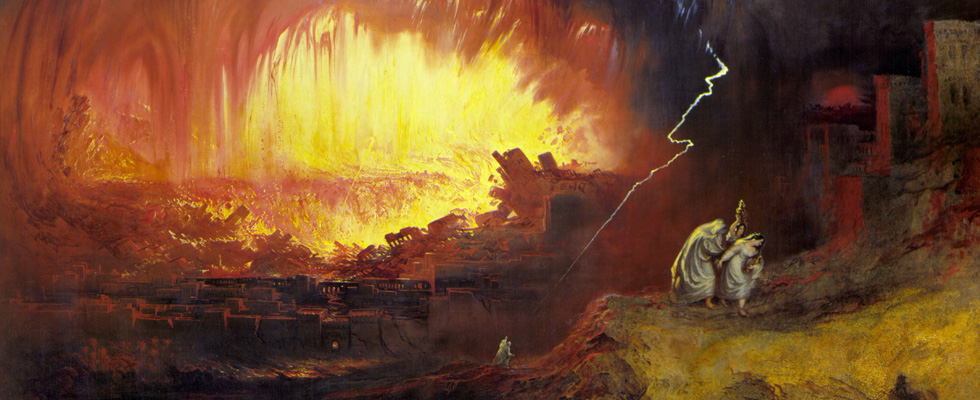
The story of Sodom and Gomorrah’s destruction begins in Genesis 18, when Abraham is met by the LORD and two angels. After the LORD told Abraham, “the outcry against Sodom and Gomorrah is great and their sin is very grave” (v.20), the two angels departed in the direction of Sodom. If God’s intentions towards Sodom were obscure at this point, Abraham’s response adds clarity: “Will you indeed sweep away the righteous with the wicked?” (v.23). Abraham knew what was about to take place, but his concern was for his nephew Lot, a resident in Sodom.
When the two angels reached Sodom, they were greeted by Lot. After urging the angels not to spend the night in the town square, the three returned to the safety of Lot’s home. Their presence did not go unnoticed however, and soon “the men of the city, the men of Sodom, both young and old, all the people to the last man, surrounded the house” (v.4). The men began to call out to Lot, demanding that he bring the two guests out so that they could have sex with them.
When Lot heard their request he approached the mob, begging them to “not act so wickedly.” Whitaker suggests it’s not the homosexual act that Lot deemed “wicked,” but the “sexual violence and rape” of those who had come under the shelter of his roof. But if Lot’s problem was only sexual violence, then why would he offer rape as a solution in the very next verse? “I have two daughters who have never known any man. Let me bring them out to you, and do to them as you please” (v.8). The men of Sodom, however, were homosexuals, and “all the people to the last man” (v.4) came out to participate in homosexual sex. When offered women as a substitute, the men refused, threatening to do worse to Lot than they had intended on doing to his guests (v.9).
Lot’s solution is abhorrent, but what it suggests is that, at least in Lot’s mind, what the men intended to do to his guests was the greater act of wickedness. To attribute the destruction of Sodom to this single event, one must ignore the context provided in Genesis 18. The great “outcry against Sodom and Gomorrah’s… very grave sin” preceded the events involving Lot and his angelic guests. What the account in Genesis 19 offers us, is an indication of the wickedness which brought the angels to the city in the first place.
If the men of the city all gathered together to gang rape two strangers, it is safe to assume sexual immorality was common practice in Sodom. Sexual immorality may express itself in numerous forms, but what we know is that the men of Sodom were homosexuals. “All the people to the last man,” preferred homosexual sex and disregarded sex with available women.
Elsewhere in the Old Testament, the sin of Sodom is described as thus: “Behold, this is the guilt of your sister Sodom: she and her daughters had pride, excess food, and prosperous ease, but she did not aid the poor and needy. They were haughty and did an abomination before me. So I removed them, when I saw it” (Eze. 16:49-50). Coincidentally, the word abomination is the very same term used to describe the act of homosexuality in Leviticus 18:22 – the same act the men of Sodom attempted to perform on Lot’s guests.
As mentioned in the article, Myth: Jesus never said anything about homosexuality, we see Jesus appealing to the authority and accuracy of the Old Testament, by making reference to a real Sodom, as an example of immense sin (e.g. Matt. 10:14-15, 11:23-24; Lk. 10:11-13, 17:28-32). Jude defines the sin of Sodom as “indulging in sexual immorality and pursuing unnatural desire [lit. strange flesh]” (Jude 1:7). The men were not only practicing sinful sex, they were sexually pursuing the wrong kind of flesh. “Unnatural,” as the ESV translates it.
The idea reminds us of Paul’s words in Romans 1, “their women exchanged natural relation for those that are contrary to nature; and the men likewise gave up natural relations with women and were consumed with passion for one another, men committing shameless acts with men and receiving in themselves the due penalty for their error” (Rom. 1:26-27).
In a passage that parallels Jude, the apostle Peter tells us the sin of Sodom was not a one off offense. Wickedness was a daily occurrence, a particular way of living that affects everyday life, and it culminated in the events of Genesis 19. According to the apostle, Lot was “greatly distressed by the sensual conduct of the wicked (for as that righteous man lived among them day after day, he was tormenting his righteous soul over their lawless deeds that he saw and heard)” (2 Pet. 2:7).
The sin of Sodom and Gomorrah was more than the attempted gang rape of Lot’s guests. In fact, the guests were there because the outcry against the city was “great” and their sin “very grave.” Their daily persistence in sexual immorality, their pursuit of unnatural desire, their practice of what God considers abominable, all led to the events surrounding the two angels and subsequently the destruction of Sodom and Gomorrah.