

It’s True: Diversity Really Is A Strength
The slogan isn’t a promise to the people—it’s a strategy for the state.


“Diversity is our strength.”
It’s a phrase so self-evident—so indisputably true—that our political leaders feel compelled to remind us of it constantly, even in the wake of a violent Islamic terrorist attack.

And do you know what? They’re exactly right. Diversity is a strength.
However, the mistake many people made was assuming that the word “our” included them.
It doesn’t.
This is because diversity is not the strength of a people. It is the strength of the state.
Once this distinction is understood, much of modern Western politics suddenly makes sense. The slogan is not a reassurance to citizens; it is an admission by those in power, even if unwittingly. Diversity strengthens them, not us.
Politicians have been remarkably candid about the trade-off required to maintain a multicultural society. Again and again, they tell us that freedom—particularly freedom of speech—is the price that must be paid to maintain multicultural communities.
In Australia, New South Wales Premier Chris Minns acknowledged this explicitly: “Australians don’t have the same freedom of speech laws they have in the United States, and the reason for that is that we want to hold together a multicultural community.”

Freedom is not compatible with multiculturalism—at least not in the way our leaders have constructed it. Speech must be regulated, opinions curtailed, moral judgments restrained, and dissent managed by the state. Not because citizens are incapable of self-government, but because a fragmented society cannot be trusted to govern itself.
And yet, if multiculturalism is incompatible with free expression, then it is incompatible with “democracy” itself. A democratic society depends on the unrestricted exchange of ideas—without fear of reprisal or prosecution. Multiculturalism, then, can only be preserved at the cost of freedom, and by extension, democracy. As such, it should be rejected as a harmful ideology—an ideology that can only be maintained through authoritarian might.
As political commentator Auron MacIntyre recently observed: “A multicultural society is by necessity a totalitarian society. That’s why your leaders, greedy for power, are all racing to ‘diversify’ the population.”
A diverse society, particularly one divided by religion, morality, and culture, requires constant supervision. Harmony does not emerge naturally; it must be enforced. And this can only be achieved through the continual erosion of freedoms.
This is because multiculturalism necessarily entertains a plurality of moral frameworks. What one group regards as virtuous, another may consider immoral. What one celebrates, another condemns. In such an environment, open moral disagreement becomes destabilising. Social fragmentation inevitably leads to social frictions.
Thus, to preserve the appearance of social cohesion, the state must therefore intervene—not to reconcile differences, but to suppress them. One group must be warned not to criticise another. Certain beliefs become untouchable. Certain truths become “harmful.” Speech is no longer judged by whether it is true, but by whether it is permitted.
The result is not genuine unity, but a superficial peace maintained by threat of punishment. It is harmony by coercion and threat of punishment.
History suggests such structures are fragile. We are already seeing their limits tested in places like the United Kingdom and Australia, where even establishment voices such as The Telegraph have begun warning of serious internal conflict—namely, civil war—if current trajectories continue.
Aristotle observed long ago that democracy, a meaningful participation of citizens in public life, was only sustainable within relatively homogeneous societies. Highly fragmented societies, he argued, tended toward despotism.
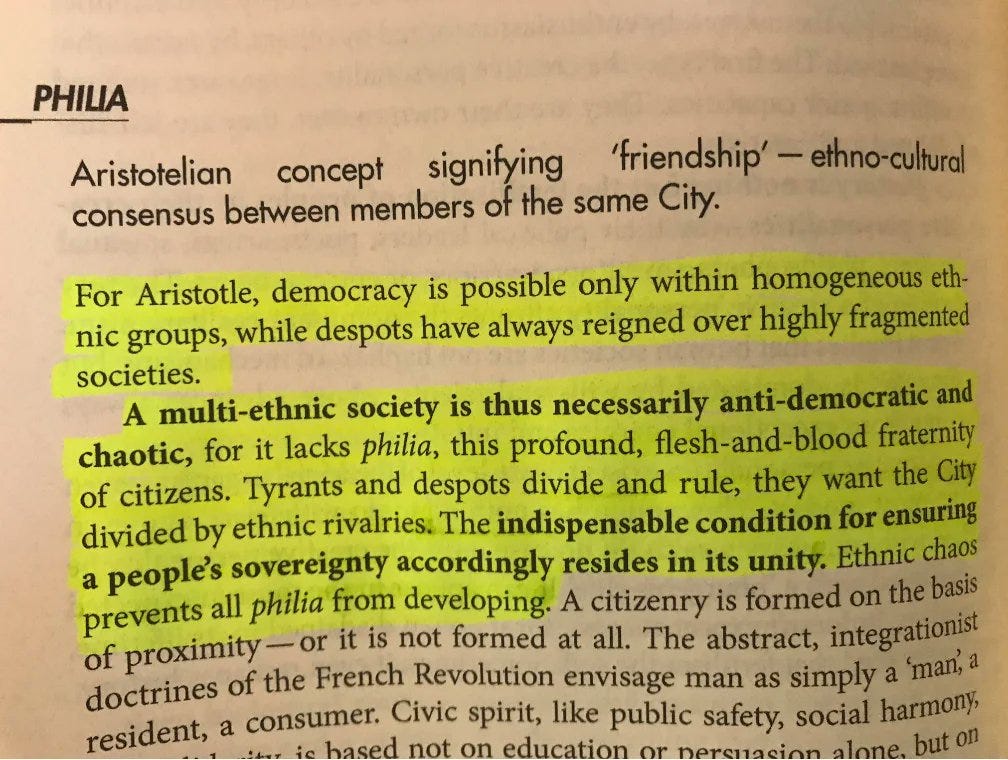
It’s obvious. Unity enables trust; fragmentation breeds suspicion. A people who see themselves as one can govern themselves. A people divided into competing groups require an external authority to rule over them. It’s the basic social principle that led to the establishment of the office of “Deacon” in the early church (see Acts 6:1-3). The chaotic division between the Hebrews and the Greeks created the need for an external authority to intervene and regulate.
This explains why so much modern political messaging is designed to fragment society—into oppressed and oppressor classes, into rival identities, grievances, and hierarchies of victimhood. Division weakens the public while strengthening the administrative state that claims to manage the resulting chaos.
A fragmented society is easier to control than a unified one. This principle has been understood since the dawn of warfare: divide and conquer. A divided people cannot resist, cannot organise, and cannot speak with a single voice.
It is, therefore, no surprise that “diversity” consistently coincides with expanded surveillance, tighter speech laws, heavier regulation, and diminishing civil liberties. The pattern is clear. Social fragmentation strengthens no one—except those who govern.
As Jesus put it, “A kingdom divided against itself cannot stand.”
The question is not whether diversity is a strength—it clearly is, but not for us. As our leaders are increasingly admitting, diversity results in more power for the state and fewer freedoms for the people.
The real question is what kind of society we want to leave our children: not a unified people bound by shared heritage, values, and mutual trust, but a fragmented society held together only by regulation, threat, and force.
Excellent article! Spot on.